Start with the introduction to the atlas →
THE GEOMETRY OF INNER LIFE · PART III · INTUITION
An idea can arrive before its reasons. We should be careful about what we appoint it to do.
“I knew it,” he says, once the evidence has arrived. His intuition has an excellent attendance record after the event.
Before the event, he had a feeling. So did three other people, in four incompatible directions. The successful feeling receives a biography. The others are discreetly retired. Soon he will explain that he has always been good at reading situations.
There is something worth rescuing from this little ceremony. Understanding sometimes arrives without a recital of the steps. A relation becomes apparent; a phrase suddenly makes sense; an answer presents itself before we can explain why it deserves to remain. The experience is familiar enough to invite confidence, and ambiguous enough to make confidence expensive.
The title of this essay therefore carries a question inside its promise. Some things we know before we can explain them. Some things merely arrive before their objections. How might we distinguish the possibilities without making a lack of explanation either a mystical credential or an automatic disqualification?
Four landmarks, with a translation problem
In The Apophatic Man, Mo gives intuition a processual axis running between understanding and reasoning, and a conceptual axis between the manifest and the hidden. These are the terms of Gariste Valois’s fictional science. The proposed arrangement of hemispheres and commissures belongs to that fiction; this essay tests an epistemological analogy.
We need working meanings before we draw. Here, understanding emphasizes grasping a configuration of sense: seeing how something hangs together. Reasoning emphasizes unfolding relations between premises, possibilities, and conclusions. They can cooperate. A proof can deepen understanding; an apprehended relation can suggest a proof. Neither side owns intelligence, and neither names a speed setting.
For this local exercise, manifest concerns what is presented or explicitly available in the specified situation. Hidden concerns a relation, rule, condition, or meaning being sought beyond that presentation. We must say what is hidden, from whom, and relative to which account. A printed sentence may be visible while its implication remains unnoticed. A secret motive may be confidently proposed and entirely imaginary.
These definitions are our interpretation of Mo’s vocabulary. They do not reproduce Kant’s technical division of faculties, Bergson’s method, or a discovered anatomy. Their usefulness depends on the distinctions they preserve in an actual example.
Three numbers and an ambitious mind
Consider a deliberately small invitation:
2, 4, 6, …
You may see eight waiting just beyond the edge. The continuation feels almost rude to question. Your mind has encountered three numbers and offered to administer the rest of infinity.
What, precisely, has become apparent? The two displayed differences are both two. That is a claim about the given terms. The claim that the next difference will also be two concerns a continuation. The second claim requires something additional: a generating rule, a convention, a purpose, or further evidence. The ease of the transition can conceal that addition.
Another rule begins with two and four and then adds the previous two terms. It produces two, four, six, ten, sixteen. Both rules fit the three terms we supplied. The example establishes a limited point: the displayed terms do not uniquely determine the next term when the class of admissible rules is unrestricted. It does not establish that all predictions are equally reasonable, or that conventions and background knowledge contribute nothing.
A school exercise that requests the simplest familiar continuation supplies a different context from a puzzle about alternative rules. Expectations belong in the account. Their contribution should be visible enough to question.
Four readings of one encounter
We can now place four descriptions in our field. First, I grasp the equal differences among the terms already displayed. Understanding emphasizes a manifest relation. Second, I subtract each adjacent pair and state the results. Reasoning makes the displayed relation explicit.
Third, I apprehend “keep adding two” as the intended continuation. Understanding reaches towards a rule not specified by the three terms alone. Fourth, I formulate that assumption and derive eight conditionally; I can also formulate the recurrence rule and derive ten. Reasoning explores what the presentation has left open.
The four descriptions can concern the same person within a minute. Their positions indicate the work being foregrounded. They do not rank the person’s rationality. A careful calculation may rest on a bad premise; an immediate apprehension may be accurate. We still need to examine the claim and its grounds.
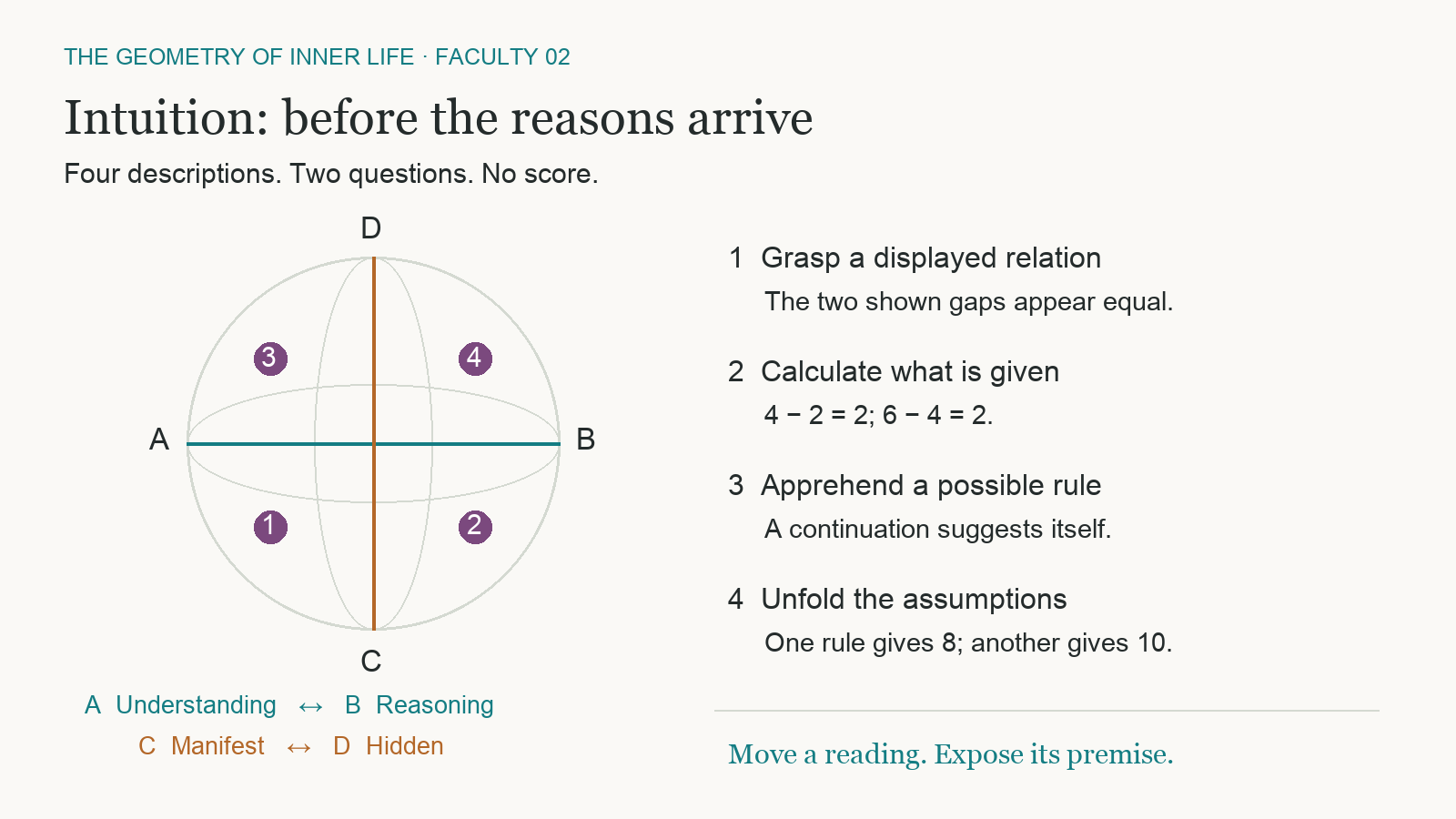
Notice how the two axes differ. Understanding and reasoning describe operations emphasized by an account. Manifest and hidden concern its object or target. Calculating the visible differences and deriving an unannounced continuation both involve reasoning, while asking different epistemic questions.
A point can consequently acquire several occupants. Two people may both claim to grasp the hidden rule: one recalls the convention of a familiar exercise, another wants eight because it feels elegant, a third has seen the designer’s instructions. Their coordinate can be shared while their grounds remain different. The record beside the point must carry what the dot cannot.
Descartes declines the invitation to guess
Descartes’s Rules for the Direction of the Mind gives intuition a demanding role. In Rule III, it is an evident intellectual apprehension by a clear and attentive mind. Deduction involves a sequence connecting what is known; its individual connections still require intuitive apprehension. The operations support each other within his method. [1]
That conception challenges the everyday habit of calling a forceful suspicion an intuition and borrowing the word’s philosophical prestige. Cartesian intuition is answerable to a standard of evidentness. The confidence of our prediction does not establish that it meets that standard.
The connection also gives our processual axis a problem worth retaining: an explicit inference can depend on relations apprehended immediately. We should allow the descriptions to overlap. Assigning Descartes to the “understanding” end and declaring the matter settled would discard the cooperation his account requires.
Kant changes the question
Kant uses intuition for an immediate relation to a given object. In human cognition, intuition belongs to sensibility, while the understanding thinks through concepts. At the opening of the Transcendental Logic, he argues that both contributions are required for cognition and that their functions must be distinguished. [2]
Our working term “understanding” therefore cannot simply inherit the authority of Kant’s Verstand. Nor does a hunch about the next number become a Kantian intuition by arriving quickly. The words participate in different architectures.
This is a boundary test for the atlas. If a philosophical account addresses the conditions under which an object can be given and thought, a chart of how someone interprets a particular puzzle may be operating at the wrong level. We can compare the questions. We must also permit a request for a different chart. A universal map that admits everything by changing the meaning of its labels has discovered a profitable way to be unfalsifiable.
Bergson objects to the furniture
In the opening of Introduction to Metaphysics, Bergson distinguishes analysis through symbols and external perspectives from intuition directed towards a reality’s singularity from within. The self enduring through time is his central example. Images may guide attention, while a collection of representations remains unable to replace the experienced original. [3]
His objection reaches the medium of our enterprise. A diagram can locate descriptions of an experience while leaving the experience’s continuity unrepresented. Turning a sphere on a screen supplies additional views of the diagram. It does not, through that rotation, give us the lived movement Bergson is trying to approach.
We can accept that limitation and retain a smaller purpose: displaying differences between our accounts, exposing assumptions, and helping an interlocutor identify what has changed. The map has a task. It need not apply for custody of the entire interior life.
A hypothesis deserves a future
Peirce’s 1878 discussion of deduction, induction, and hypothesis offers a useful comparison. His example of white beans distinguishes applying a rule to a known case, generalizing from cases, and proposing a case that would explain a result. The hypothetical step can suggest an explanation without deductively establishing it. [4]
Our leap from the displayed numbers to an unstated rule has an explanatory ambition: this rule would make sense of what we see. We need not identify every such leap with Peirce’s classification to ask its practical question. What would follow if the proposal were correct, and what encounter could make it untenable?
In The Fixation of Belief, Peirce also separates the validity of an inference from our impulse to accept its conclusion. [5] That distinction should remain legible beside every attractive point on our map. Conviction is an event in the life of a judgment; it is insufficient as the judgment’s warrant.
A useful intuition can therefore incur a debt. It offers something to investigate: a candidate relation, a possible interpretation, a question that changes what we inspect. The debt concerns the account we can give of it, the alternatives it overlooks, and its conduct when the next piece of evidence arrives.
Three changes that deserve separate controls
The playable exercise keeps three changes apart. Articulating a route adds a premise and its consequences to the record. That may justify revising the proposed processual placement. The exercise leaves the point still until you choose to move it, so that the change in the account can be inspected first.
Encountering another term changes the information available in the constructed example. A fourth term of ten defeats the constant-increment rule for this displayed continuation. It fits the recurrence proposal. That fit does not prove that every subsequent term must obey the recurrence: additional rules can agree over a longer finite segment.
Rotating the view changes the drawing alone. Your prediction, recorded reasons, and coordinates remain fixed. The depth of the sphere has no additional established epistemic quantity attached to it. A richer-looking image supplies no extra evidence.
The distinction between manifest and hidden is consequently relative to a question. Once ten is displayed, the fourth term is manifest in this example. The general rule may remain a hypothesis. We may revise the object of inquiry rather than imagine that the world has crossed a permanent border between two anatomical territories.
Play the conceptual sphere
Open the interactive intuition lab →
Make a prediction, expose its premise, drag the readings, rotate your view, and compare two possible continuations. Keyboard controls are available. Your choices produce no personality score.
Two cases that refuse an easy definition
Suppose I cannot explain why I think a visitor is lying, and later discover that she told the truth. Everyday speech may call the initial judgment an intuition. Calling it knowledge would erase the failure we need to understand. “Before I can explain it” leaves truth unsettled.
Now suppose I know a friend’s address but cannot remember whether I learned it in a message or a conversation. The knowledge may have a perfectly ordinary history of testimony and memory. My present inability to reconstruct the source does not, by itself, turn it into intuition. The absence of an articulated route is shared by cases with different origins.
These are conceptual counterexamples, not clinical results. Together they prevent us from defining this faculty simply as knowledge without an available explanation. They also suggest two questions our interface must keep distinct: how did this thought arise, and what makes accepting it reasonable? A causal story about the first can leave the second unresolved.
Where this sphere should stop
For this episode, a candidate belongs in the local field when the account concerns apprehending or working out an intelligible relation between what is available and what is being sought. That boundary is provisional. It overlaps attention, memory, creativity, and language. The later episodes must investigate the overlaps instead of treating the names as sealed compartments.
A description with neither a stated question nor grounds for comparison may remain unplaced. The interface includes that option. Refusing a coordinate can preserve a distinction that the model has not earned the right to compress.
The centre presents a further difficulty. Understanding and reasoning can be intensely active together, or both barely engaged. A relative position can conceal that difference. Our record therefore retains words, assumptions, and alternatives; the geometry supplies no measure of their strength.
The atlas’s ambition is to make unfamiliar conceptual relations examinable. A supposed empty place becomes interesting when we can describe what would belong there, explain how it differs from its neighbours, and specify a counterexample. Unoccupied pixels do not predict an undiscovered philosophy. The constraint must do some intellectual work before the vacancy deserves a name.
When the next number arrives
The man who knew it all along can retain a more interesting version of his gift. He can report the thought when it arrives, state what he thinks it concerns, and leave enough of a record to meet its failure honestly. He can allow an immediate grasp to prompt inquiry without making slowness a virtue in itself.
Sometimes the reasons will vindicate the apprehension. Sometimes they will replace it. Sometimes the thought will remain fruitful and uncertain. Those are different outcomes, and a useful atlas should help us keep them different.
Eight waits at the edge of the sequence. Ten has equally respectable paperwork. Before inviting either to govern infinity, we might ask who wrote the invitation.
Sources and scope
This is speculative epistemology developed from Mo and Gariste Valois in Marius Tianu’s The Apophatic Man. The axes, placements, and number exercise are interpretive constructions, not validated neuroscience, psychological measurements, or a historical consensus. AI assistance contributed to research, drafting, editorial development, and interactive design.
- René Descartes, Rules for the Direction of the Mind, Rule III, in The Philosophical Writings of Descartes, vol. I, translated by John Cottingham, Robert Stoothoff, and Dugald Murdoch (Cambridge University Press, 1985), pp.13–15; AT10:366–370. Publisher preview.
- Immanuel Kant, Critique of Pure Reason, A19/B33, Transcendental Aesthetic §1, and A50/B74–A51/B75, introduction to Transcendental Logic I. University of Washington transcription; A/B references identify the standard editions, not the transcription’s page numbers.
- Henri Bergson, “Introduction à la métaphysique”, Revue de métaphysique et de morale11 (1903), opening pp.1–9, reproduced by the University of Wuppertal. The comparison concerns the opening distinction and its limits for representation.
- Charles S. Peirce, “Deduction, Induction, and Hypothesis”, Popular Science Monthly13 (August1878), pp.470–482, §I. The local number exercise is ours; Peirce’s example concerns beans and forms of inference.
- Charles S. Peirce, “The Fixation of Belief”, Popular Science Monthly12 (November1877), pp.1–15, §II.
Next faculty: Attention — What the Figure Lets You Overlook →

