Start with the introduction to the atlas →
THE GEOMETRY OF INNER LIFE · PART II · EMPATHY
You say you understand how I feel. Before accepting this small act of conquest, I would like to know how you found out.
You make a joke. The table laughs. One person does not. A small silence opens beside the laughter, and you fill it with an explanation: she is too sensitive.
The explanation is attractive. It preserves your wit, locates the defect elsewhere, and requires no additional conversation. It has everything an efficient explanation needs except a reason to believe it.
Perhaps she is hurt. Perhaps she is distracted. Perhaps she has heard the joke before and considers your confidence the evening’s more interesting performance. You have encountered a face and furnished it with an interior. Most of us do this with the ease of property developers.
Empathy enters here as a problem of understanding: how another person’s experience becomes available to me, and what survives the passage. The flattering version promises intimacy. The difficult version asks whether I have met another subject or merely arranged my own furniture in a second apartment.
Four ways to inhabit one silence
In the fictional science of Gariste Valois, introduced in the previous essay, Mo gives empathy two axes: introspection ↔ extrospection and awareness of self ↔ awareness of otherness. We borrow these as a philosophical construction. Valois’s science belongs to The Apophatic Man; the uses and failures of this diagram belong to our argument.
The first axis concerns the approach: examining my experience, or attending outward to expression, action, testimony, and circumstances. The second concerns the subject whose perspective the interpretation brings forward: myself, or another person recognized as someone for whom the world appears. Otherness includes the familiar person whose response still surprises me.
These distinctions offer four readings of the silence. In the first, I inspect my intentions. I wanted to amuse, not wound. My embarrassment becomes evidence about what I wanted and what I fear the room now thinks. This is inward inquiry organized around myself. It can disclose a motive. It cannot establish what the listener felt.
In the second, I notice what happened outside me and ask what it reveals about my participation. My joke made her the entertainment; the laughter gave me an audience at her expense. Here an outward encounter changes my account of myself. The other person’s response enters self-understanding. My innocence has acquired a witness who may decline to confirm it.
In the third, I remember being laughed at and imagine her experience through that memory. Inward attention now serves a conjecture about someone else. The memory may suggest a question I would otherwise miss. It may also impose an injury she never suffered. My past has offered its services as a translator. Its credentials remain to be checked.
In the fourth, I attend to her expression, hear her account, and ask about the situation. She says the joke repeated something a colleague has been saying for months. The silence begins to have a history beyond this table. Inquiry turns outward while preserving her experience as the question.
These are readings of an encounter. None supplies a permanent address for either participant. One conversation can contain all four, overlap them, or leave some unused. Their differences concern the work an interpretation does, and each deserves examination.
Imagination has an excellent publicist
Adam Smith gives imagination a central role in sympathy. In The Theory of Moral Sentiments, we approach another’s suffering by conceiving ourselves in the sufferer’s situation. He also insists that circumstances matter: an angry expression can repel us before we know its occasion, and knowledge of the situation changes our response. [1]
The connection helps us identify a temptation in our third reading. Imagination can loosen the authority of my present comfort. It lets an unfamiliar injury become conceivable. But conceivability is a modest achievement. I can imagine an experience vividly and attribute it falsely. My tears do not notarize your biography.
Smith’s account also links judgments of propriety to the spectator’s actual or conditional sympathetic response. This raises a question our atlas must keep open: when does bringing your situation home to myself illuminate it, and when does my response become a tribunal before which yours must seek permission? His theory provides the philosophical pressure; the coordinate scheme is our extension.
Consider the sentence, “I would never be offended by that.” It reports something about the speaker’s anticipated reaction. Delivered as a verdict on another person, it tries to make that reaction a jurisdiction. The person who cannot imagine your injury may have reached the border of his imagination. He has not thereby established the border of injury.
Several stories, one point
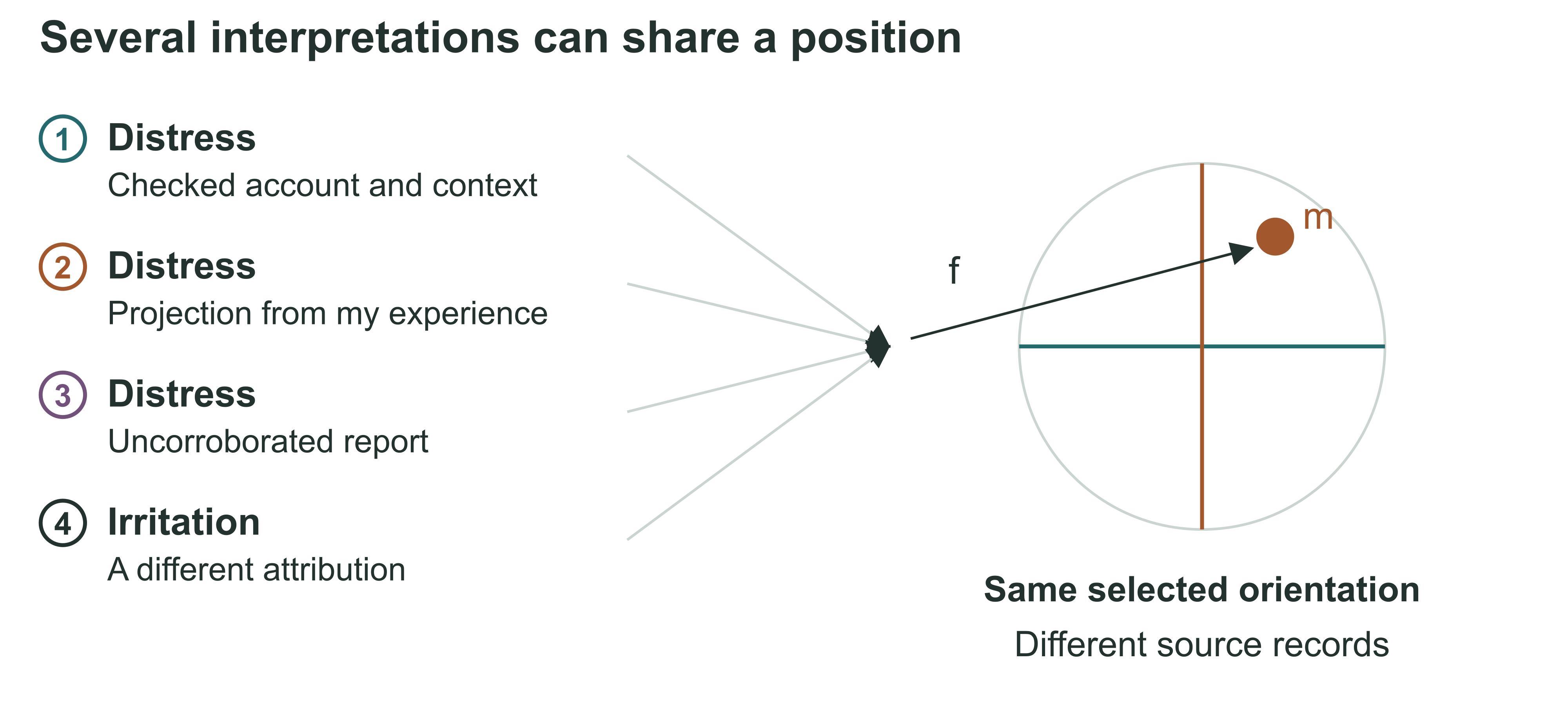
Suppose our chart places an interpretation towards outward inquiry and otherness. What have we learned? We know its stated orientation. We still need its claim, its reasons, and the circumstances under which it could be corrected.
Four interpretations could receive the same coordinates under a deliberately coarse rule: each attempts to interpret her outward response as her experience, while its evidential route remains unrecorded. The first attributes hurt after listening to the woman and learning the relevant history. The second also attributes hurt, but rests on a projection: everyone secretly feels what I would feel. It advertises interest in her experience while supplying the content from mine. The third relies on someone else’s report that she was hurt. The fourth attributes irritation with an interruption, while remaining equally concerned with her perspective.
Their shared position conceals different contents and grounds. A report may be reliable or careless; testimony may face counterevidence; projection may accidentally arrive at the truth. The point cannot settle these matters. Two or more interpretations can occupy it without becoming the same interpretation or earning the same confidence.
Now she explains that she missed the joke because she was reading an urgent message. The first attribution loses its support. Our inquiry can remain outward and directed towards her while its claim changes. Evidence has improved without any required movement across the chart.
Conversely, I may drag my interpretation towards otherness while acquiring nothing beyond an appetite for appearing considerate. A coordinate changes. My reasons do not. The map can record a new emphasis and leave the original mistake intact.
Rotating the diagram does even less: it changes our view of the representation. The plotted relation remains where it was. A pleasing turn of the sphere can make a thought easier to inspect. It cannot answer a question the thought has avoided.
The self receives visitors
There is a further inconvenience. Looking outward can change the person who looks.
David Hume introduces sympathy in his discussion of reputation and the influence of other people’s opinions on pride and humility. He distinguishes receiving their sentiments through sympathy from taking their judgment as a reason, while recognizing that both affect how we judge ourselves. [2] This is useful to the atlas because social influence and justification can travel together without being identical.
When the woman describes the joke, I may feel my charm evaporate before I accept her criticism. I can be wounded by a judgment I consider unjust. I can also find a criticism sound while resenting its author with impressive sincerity. The social formation of self-understanding includes friction, resistance, and selective hearing.
George Herbert Mead makes a stronger proposal: the reflexive self develops through social experience, including taking others’ attitudes towards oneself. In Mind, Self, and Society, responding to my own speech as others respond can redirect what I say next. [3] Our second reading has a clear connection with this account. It does not compress Mead’s theory into a point.
The connection explains why awareness of otherness can participate in awareness of self. It also complicates the title. Other people help me recognize myself; the encounter can have a reflective function. The mistake begins when I grant another person significance only as the surface on which my identity returns to me. She can reveal something about me and still be occupied with a life whose central problem is elsewhere.
The considerate interrogator
A more serious objection concerns the name of the faculty. If empathy deserves praise, why include a successful manipulator anywhere within its field?
Imagine someone who understands exactly why the joke hurts and repeats it when maximum humiliation is useful. He recognizes the listener’s vulnerability as hers. His accuracy serves cruelty. Another guest may care deeply while misunderstanding the entire exchange. A third understands the injury, wants it relieved, and disagrees with the demand that the speaker be excluded from every future gathering.
These possibilities separate three questions: what do I understand, what do I want for you, and what do I endorse? Understanding, care, and agreement can support one another. Their conjunction needs to be shown in the case. The word empathy cannot do the work by moral suggestion.
For this essay, a candidate empathic interpretation must retain some recognition of another person’s experience as another’s. That boundary is a working commitment of our model. If I feel distress without distinguishing its possible source in you from its occurrence in me, the description needs more than an assertion of fusion. If I correctly identify your fear to exploit it, the understanding remains answerable to evidence and its purpose remains open to condemnation.
Preserving the distinction between us also permits disagreement. Your account matters to understanding your experience; your wishes do not automatically settle what everyone should do. I can believe that you felt insulted and question an accusation about intention. I can accept that intention was benign and still judge the joke careless. An encounter contains more claims than either person owns outright.
The centre conceals a crowded room
Our diagram faces its strongest objection in a conversation that goes well. Imagine attending intensely to your words while examining my defensiveness, acknowledging your hurt while recognizing my own embarrassment. Self and other are both vividly present. Inward and outward inquiry cooperate. A relative chart might place this encounter near the centre.
It might place a thin, halfhearted exchange there too, if each side of both contrasts receives equally weak emphasis. Balance records a relation and suppresses how much engagement lies behind it. The centre can conceal two people doing difficult work or a conversation barely occurring.
This is a counterexample to any claim that position alone measures empathy. It also blocks the idea that moving towards otherness necessarily weakens self-awareness. Recognizing my defensive impulse may be precisely what lets me hear you. Your reply may sharpen my awareness of what I have done.
A chart of relative emphasis must keep these differences available in words or additional records. Where neither term is engaged, we may have insufficient grounds to place the interpretation at all. An empty account does not earn a balanced coordinate by default. The model must permit uncertainty and refusal to plot.
Move the reading. Keep the reasons visible.
Open the interactive empathy lab →
Select four interpretations at the same position. Ask for more context without moving the point. Move the point without acquiring new evidence. Rotate the map without changing the interpretation. Pointer gestures and keyboard controls are available.
Then try the four-situation quiz →
Leave room for an answer
The atlas becomes useful when a position prompts questions: what claim am I making, whose experience is at issue, what am I using as evidence, and what reply could change my mind? Its usefulness diminishes whenever a location answers those questions on our behalf.
This is a local proposal for comparing interpretations. It establishes no universal inventory of empathy, no scale of psychological capacity, and no neurological mechanism. Philosophical accounts enter as arguments that challenge or illuminate it. Their authors have not been assigned numerical residences in our sphere.
At the table, the speaker can begin with something embarrassingly ordinary: asking what happened, then listening long enough for the answer to differ from his preferred explanation. The result may exonerate him. It may require an apology. It may leave the matter uncertain.
He has relinquished one pleasure: the immediate possession of another person’s meaning. In return, he has acquired the possibility of discovering it. The silence beside the laughter belongs to someone who can answer back.
Sources and scope
This essay develops speculative epistemology from Mo and Gariste Valois, fictional figures in Marius Tianu’s The Apophatic Man. The axes and examples are interpretive proposals. Source connections below do not establish the diagram’s geometry or validate its placements. AI assistance was used in research, drafting, and editorial development.
- Adam Smith, The Theory of Moral Sentiments, Part I, Section I, chapters I–III: imaginative change of situation, contextual understanding of passions, and sympathy in judgments of propriety. Smith’s sympathy is not assumed to coincide with every present use of empathy.
- David Hume, A Treatise of Human Nature, 2.1.11, especially paragraphs 1–3 and 9: reputation, communication of sentiments, and the separate roles of sympathy and reasoning about another’s judgment.
- George Herbert Mead, Mind, Self, and Society, §18 (1934), edited by Charles W. Morris, especially pp. 138–141: becoming an object to oneself through social attitudes and responding to one’s own speech. This is a connection with socially mediated self-understanding, not an identification of Mead’s account with our chart.
Next faculty: Intuition — What You Know Before You Can Explain It →

