THE GEOMETRY OF INNER LIFE · PART I
Eight faculties, sixteen axes, and an uncomfortable possibility: some of our arguments begin because we use the same word from different positions.
At dinner, a man announces that he knows himself. His sister looks up. His wife puts down her glass. Somewhere in the room, three incompatible autobiographies have just acquired the same author.
He means that he recognizes his motives. His sister means that he has forgotten half his childhood. His wife means that his account of his motives has enjoyed a suspiciously generous editorial policy. They could argue until breakfast. They probably will. Yet before deciding who is wrong, it might help to ask what each of them is calling self-knowledge.
We are very good at demanding definitions. We are less interested in examining the position from which a definition becomes convincing. A dictionary makes an admirable peace treaty. It has limited jurisdiction over a family.
This series proposes an atlas: eight faculties of synthesis, each explored through two interacting axes. It begins in the speculative science of Gariste Valois, a fictional researcher in The Apophatic Man. Valois calls his enterprise nevraxo-pregnance. His ambition is to alter the relationships through which a mind composes experience and recognizes it as its own. We take that fictional apparatus as an invitation to construct a philosophical model. Its anatomy and experimental powers belong to the novel. The conceptual distinctions, and the arguments we make with them, must answer to ordinary philosophical scrutiny.
Start with four landmarks
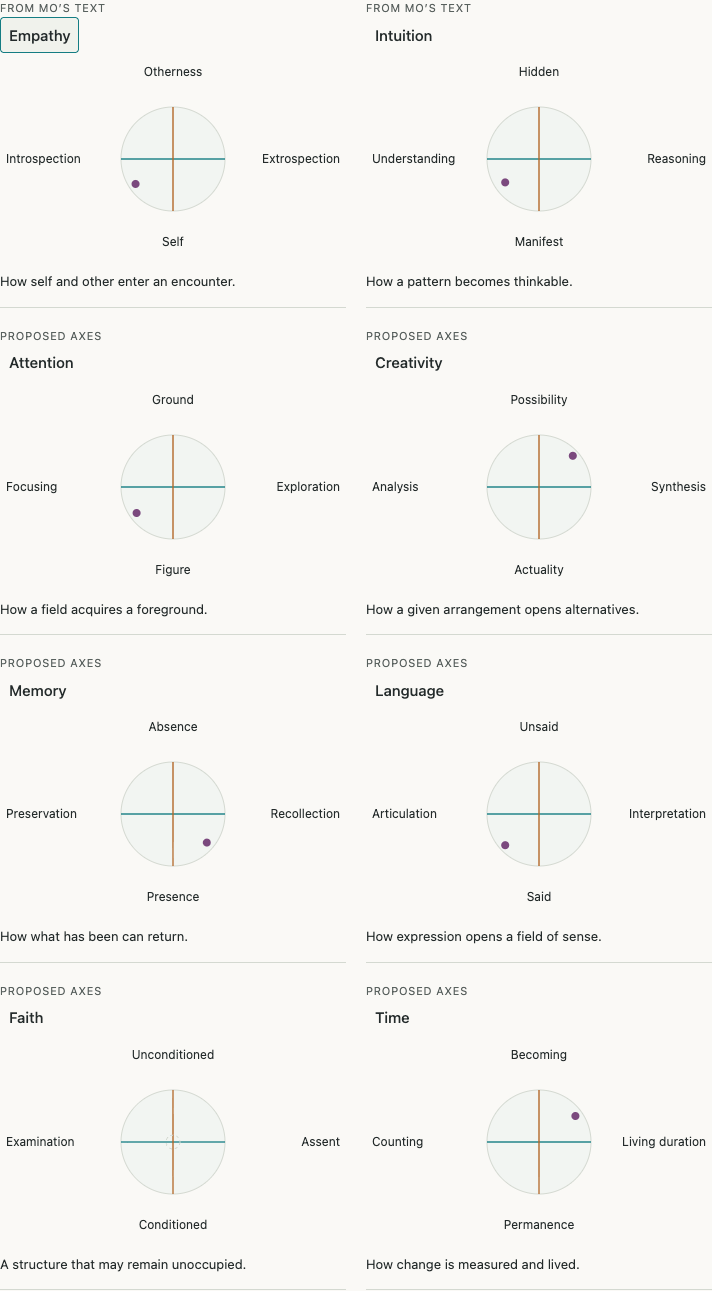
Mo, the novel’s guide to this science, gives empathy two axes. The first joins introspection and extrospection: attending to one’s experience and attending outward to people, actions, and circumstances. The second joins consciousness of self and consciousness of otherness: recognizing experience as mine and recognizing another person as a subject whose perspective is not exhausted by mine.
For our purposes, extrospection names an outward direction of inquiry. Otherness does not mean that somebody is strange, foreign, or unlikeable. It concerns the difference between encountering an object and encountering someone for whom the world also appears.
These give us four landmarks. They do not give us four people, four brain compartments, or four mutually exclusive experiences. I can examine my embarrassment while noticing another person’s expression. I can recognize myself and acknowledge someone else in the same encounter. A bipolar field specifies a tension between reference terms; it does not require one term to disappear whenever the other matters.
Why one axis is processual
The distinction concerns the questions the axes ask. The processual axis asks: through what operation is this understanding being formed? In the empathy example, attention can turn inward towards experience or outward towards an encounter. The conceptual axis asks: which relational distinction is being negotiated? Here, it is the relation between self and otherness.
Mo calls the first axis sagittal and the second transverse, within Valois’s imagined account of hemispheric contributions and commissural synthesis. We retain those names as the terminology of the model. Their usefulness in this series depends on whether we can distinguish operations from conceptual relations. Their names do not establish a neurological mechanism. Real research on interhemispheric disconnection does not supply this atlas or a simple rule for counting conscious selves. [1]
Nor are the two axes guaranteed to be independent. What I discover about myself may change what I notice about you. Your reply may reorganize what I can admit about myself. The cross on the page is a starting construction; its right angle is a drawing convention, not a discovery that the processes are causally orthogonal.
What moves when a definition moves?
Consider four possible readings of self-consciousness. I recognize myself by examining how an encounter feels. I recognize myself in what my body does and in the consequences of my actions. I understand myself through another person’s response. I understand myself through what I owe that person.
The first emphasizes reflection, the second embodied agency, the third social recognition, and the fourth responsibility. These are illustrative descriptions, not four entries in an established clinical taxonomy. They make different demands on the four landmarks. The same person can move among them during a single conversation.
This requires a distinction between a landmark and a situated instance. “Consciousness of self” can name one reference pole of the diagram. A particular way of being conscious of oneself can occupy an interior position, including a position that depends strongly on awareness of another. The label’s two uses must remain visible. Otherwise we would quietly turn a coordinate into the thing it was supposed to help describe.
Suppose I discover that my joke hurt you. At first I search my intentions: I meant no harm. Then I attend to your reaction. Finally, I may recognize something about myself through the difference between what I intended and what you experienced. Otherness has entered the account of the self. I have not become you. My account of myself has acquired an obligation to something it cannot settle by introspection alone.
That movement can clarify a dispute. It can also reveal a real disagreement. Two descriptions occupying the same field need not both be true. A person may misunderstand a gesture, invent a motive, or misremember an event. Membership in the atlas gives us a way to compare claims; evidence and argument still determine what the claims deserve.
Explore the interactive atlas and the full illustrated article →
From a cross to a sphere
Four endpoints alone are insufficient to produce the space we want. We first admit intermediate relational positions and choose a circular domain in which to draw them. This gives a disc. Rotate that disc around one of its diameters and its positions sweep out a solid ball. Its boundary is a sphere. We use conceptual sphere as the readable name for the whole field, including the interior.
The geometric construction is exact once we choose the disc. Choosing a disc for meaning is a further modeling assumption. Four concepts do not prove that their relations possess spherical symmetry. The image is useful because it lets us keep multiple relationships in view while turning the field to inspect it.
The screen also compresses distinctions that may have no natural numerical limit. It does not tell us that consciousness has a measurable radius. No distance displayed here is a psychological score, a unit of moral worth, or a quantity of empathy. Before such distances could explain anything empirically, we would need justified coordinates, a meaningful measure, and evidence that the measure preserves the differences we care about.
Two movements in the explorer therefore have different roles. Dragging a point changes a suggested relational configuration. Dragging the background rotates the view, leaving that configuration unchanged. The separate field-rotation control demonstrates the geometric sweep. We have not assigned a distinct philosophical quantity to its angle; moving it does not, by itself, discover a new kind of consciousness.
Eight fields, sixteen axes
Mo explicitly supplies both axes for empathy and intuition. For intuition, the processual terms are understanding and reasoning; the conceptual terms are manifest and hidden. We preserve these as the starting vocabulary of the fiction. “Intuition” already has several philosophical uses; the later essay will have to distinguish them rather than pretend that the diagram has reconciled them.
The six other fields below are proposals developed for this series. They use philosophical vocabulary to ask which operations and relational tensions might sustain a useful field. Their placement together is the present atlas, not a classification inherited intact from Kant, Bergson, or anyone else.
Empathy
Processual: Introspection ↔ extrospection
Conceptual: Self ↔ otherness
Mo’s formulation
Intuition
Processual: Understanding ↔ reasoning
Conceptual: Manifest ↔ hidden
Mo’s formulation
Attention
Processual: Focusing ↔ exploration
Conceptual: Figure ↔ ground
Proposed
Creativity
Processual: Analysis ↔ synthesis
Conceptual: Actuality ↔ possibility
Proposed
Memory
Processual: Preservation ↔ recollection
Conceptual: Presence ↔ absence
Proposed
Language
Processual: Articulation ↔ interpretation
Conceptual: Said ↔ unsaid
Proposed
Faith
Processual: Examination ↔ assent
Conceptual: Conditioned ↔ unconditioned
Proposed
Time
Processual: Counting ↔ living duration
Conceptual: Permanence ↔ becoming
Proposed
The proposals have different strengths and different problems. Preservation may be a condition of recollection rather than an operation interchangeable with it. Figure and ground can change roles. Living duration may resist treatment as a coordinate at all. A broad field of faith must accommodate commitments whose relation to the unconditioned is disputed. Those are questions each essay must examine. A pleasing arrangement of sixteen terms is an excellent way to begin fooling oneself.
Three philosophers who keep the drawing honest
William James describes attention as selective: consciousness emphasizes some parts of what is available and withdraws from others. His account helps motivate a field in which foreground and background matter. It does not establish our axes or their numerical placement. [2]
Kant creates a different difficulty. In the Critique of Pure Reason, the unity of apperception concerns the possibility of representations belonging together in one self-consciousness. This is not simply a report of how intensely somebody looks inward. If we placed Kant’s account at an “introspective” location and declared it explained, we would have confused a condition of cognition with an episode of psychological observation. The atlas must identify the level of a claim before it proposes a location. [3]
Bergson’s objection cuts into the medium of the atlas itself. In Time and Free Will, he distinguishes lived duration from homogeneous time represented through spatial separation. Conscious states can interpenetrate; setting them beside one another may alter what we are trying to understand. A picture of inner life risks displaying the convenience of analysis while losing the continuity of living. Our moving point cannot be offered as a substitute for that continuity. [4]
There is also an established research program devoted to conceptual spaces. Peter Gärdenfors represents concepts through geometric structures organized by quality dimensions. That provides a relevant precedent for asking what dimensions and similarities a representation should preserve. It does not validate this atlas’s eight faculties, paired axes, or spherical form. Those commitments remain ours to defend. [5]
A place is not yet a valid definition
Every point in a rendered ball is geometrically available. Its philosophical admissibility requires an argument. For each field we must specify what survives its transformations. A reading of self-consciousness must retain some account of self-relation or the attribution of experience. Awareness of another may help form that account. If no self-relation remains, we need to explain why the description still belongs to that concept.
A candidate must also preserve distinctions the argument needs. Recognizing another person’s pain is different from sharing it; sharing it is different from knowing its cause; knowing its cause is different from wanting to relieve it. One word can cover nearby operations without making them identical. This is why the empathy sphere must accommodate both care and calculated cruelty. Understanding another’s vulnerability can improve either.
The explorer supplies suggested readings, including provisional descriptions of less familiar regions. Its free movement is a device for questioning those readings. It does not certify every location as a defensible doctrine. When a description stops making sense, that failure is information about the proposed field.
What the empty places would have to predict
Mendeleev is an attractive patron for an atlas with gaps. He is also an exacting one. The periodic system earned its predictive force through regularities in the elements and successful expectations about missing ones. [6] Here, no comparable law has yet been demonstrated. A sphere leaves infinitely many drawable points. That alone predicts nothing.
A useful empty place must come with constraints. We should be able to say what relationships a candidate would preserve, what would distinguish it from neighboring concepts, and what would make us reject it. We can then search philosophical texts, formulate an example, or discover that an apparently new region already has several names.
Consider a proposed awareness of myself formed through a perspective I recognize as another’s, while I remain unsure whether I endorse its judgment. That description gives us a question to investigate. It may connect with existing accounts of recognition, alienation, shame, or internalized judgment; those connections would have to be argued. Calling the position “undiscovered” before doing that work would be a remarkably efficient form of intellectual colonialism.
The person who moves through it
The eight fields can influence one another. A new interpretation changes what memory brings forward. An encounter changes what attention selects. A commitment changes which future seems worth imagining. A model of personality would concern the relatively stable way those interactions are organized across a life.
That proposal deserves its own test. We have not established that eight faculties exhaust cognition, that a faculty always requires exactly two axes, or that an atlas of concepts explains why experience has a subjective character. The later essays will ask what the model can reconstruct and what it must leave unresolved. A diagram becomes more trustworthy when we know where it fails.
The man at dinner has not yet been refuted. He has, however, lost the right to use “I know myself” as the end of the conversation. His sister’s memory, his wife’s response, and his own intentions have become part of a field whose relations he must examine.
He might discover that the self is easier to defend from one position than to understand from another. This is where the series begins.
Next in the series: The Other Is Not Your Mirror.
Sources and scope
This is a work of speculative epistemology developed from a fictional science in Marius Tianu’s The Apophatic Man. The diagrams are interpretive models. The six proposed axis pairs and all plotted positions belong to this series; they are not findings attributed to the authors cited below.
- Yair Pinto et al., “Split brain: divided perception but undivided consciousness”, Brain 140 (2017), 1231–1237. A study of two patients; it does not establish a universal rule about the number of conscious subjects.
- William James, The Principles of Psychology, vol. I (1890), chapters IX and XI, on the stream of thought and attention.
- Immanuel Kant, Critique of Pure Reason, especially B131–B136, on the original synthetic unity of apperception.
- Henri Bergson, Time and Free Will (1889), chapter II, on qualitative multiplicity, duration, and spatial representation.
- Peter Gärdenfors, Conceptual Spaces: The Geometry of Thought (2000). Geometric representation supplies a precedent, not an endorsement of the present model.
- Dmitri Mendeleev, original papers on the periodic law (1869, 1871), collected by Moscow State University; see also the Smithsonian’s account of Grundlagen der Chemie (1891).
Try the four-situation empathy experiment →
AI assistance contributed to research, drafting, diagram design, and editorial development.

