Start with the introduction to the atlas →
THE GEOMETRY OF INNER LIFE · PART IV · ATTENTION
What you call obvious often means that you have already chosen what deserves a foreground.
At dinner, someone says she listened carefully. She can repeat every word of the argument. She cannot tell you that the person speaking was frightened. Accuracy has given her an alibi, and she means to use it.
Another guest notices the trembling hand and misses the sentence that explains it. Both will leave with an account of what happened. Both accounts can be sincerely attentive. Neither is complete. The comfortable mistake is to imagine that attention is a camera with a sharper lens: turn the dial, and the whole truth acquires better resolution.
Attention selects, holds, shifts and sometimes reorganizes. It can make a detail available for judgment while leaving another detail in the same visual field. Yet “in the field” does not mean “registered,” and “registered” does not mean “understood.” We need an atlas that can show what an account foregrounds without pretending that a dot explains the mind that produced it.
Four landmarks we have to earn
Mo, in The Apophatic Man, names attention among the eight faculties of Valois’s fictional system but does not give this faculty its four explicit poles. The pairings here are our proposal, not a recovered page of his theory and not neuroanatomy.
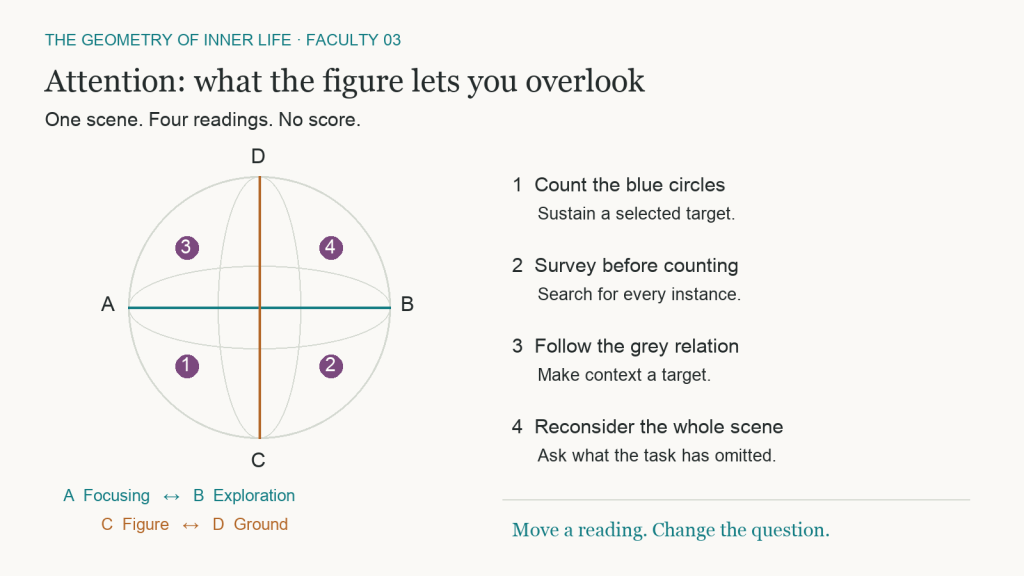
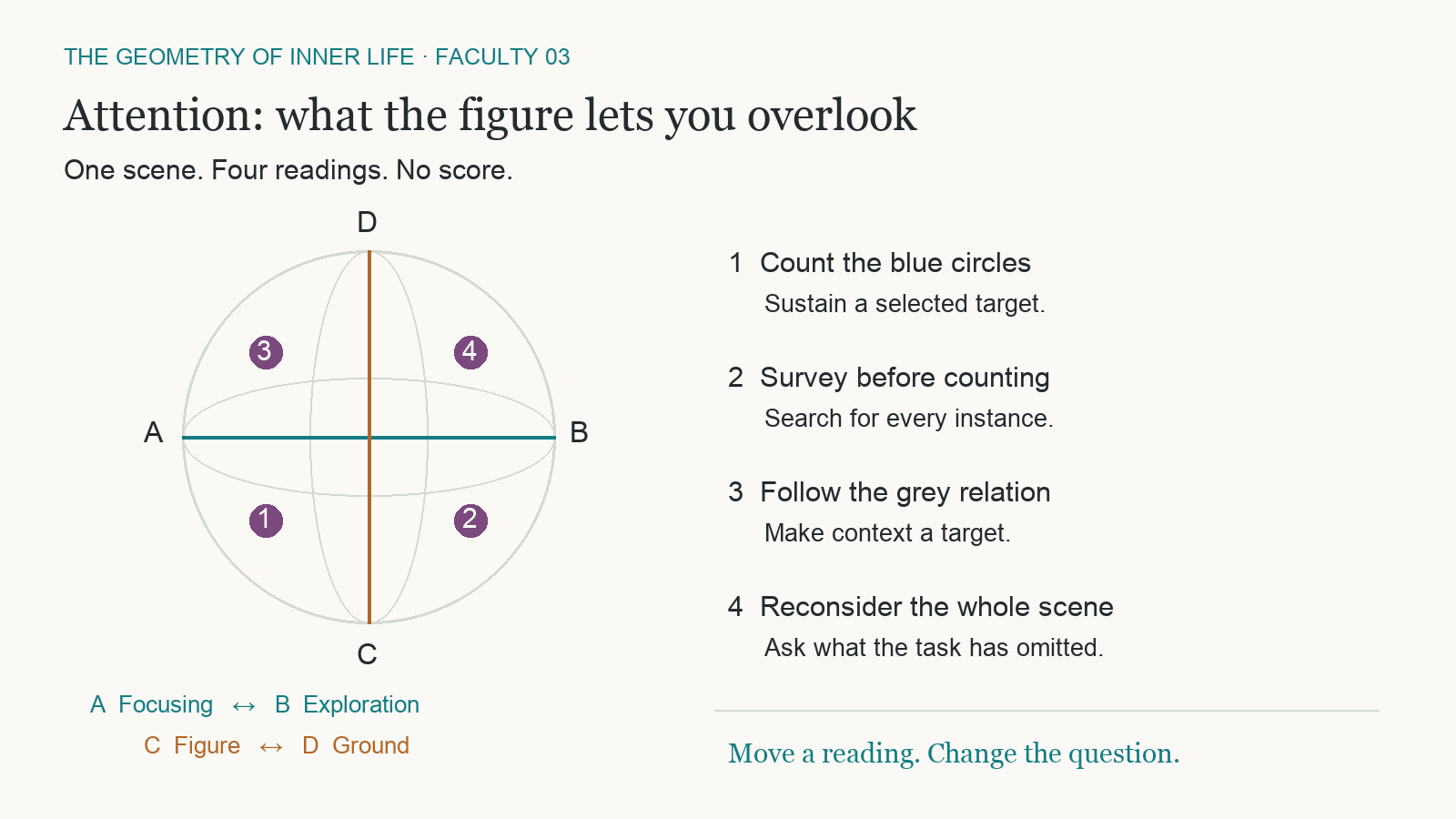
The processual relation runs from focusing towards exploration. Focusing means sustaining or refining a selected question. Exploration means surveying alternatives, moving between possible targets, or looking for what a current question has excluded. Neither is a virtue by itself. A detective may inspect one trace with exquisite care and miss the door through which the suspect left. Another may visit every room and examine nothing long enough to learn its significance.
The conceptual relation runs from figure towards ground. Figure is what an account makes the explicit object of inquiry; ground is the context, relation or horizon against which that object appears. These are roles within a description. A background can become a figure when the question changes. The ground is not automatically unconscious, invisible or unimportant.
The four words do different jobs. Focusing and exploration concern how an inquiry proceeds. Figure and ground concern what becomes thematic in that inquiry. A person can explore a figure by examining its parts, or focus on a background relation. This is why the axes cross instead of merely repeating one contrast twice.
A diagram with no hidden ink
Consider the same constructed image: a red square, several blue circles, a thin grey line, and a small amber triangle. Ask first, “How many blue circles are there?” A count becomes your figure. You may focus tightly on each circle or explore the entire arrangement to make sure none is missing.
Ask instead, “What does the grey line connect?” The pixels have not changed. The relation among the shapes may now organize the answer. The circles do not vanish; their role in the account changes. Ask a third question: “Why did I ignore the amber triangle?” You have moved from describing the display to investigating your own selection. The question itself is now part of the evidence you must report.
Our four sample positions make these differences legible. One: carefully count the blue circles as the target. Two: scan the display for every circle before counting. Three: hold the line’s relation to the shapes in view. Four: survey how the line, triangle and circles change one another’s significance. These are proposed descriptions, not findings about a visitor’s attention. Someone could reach the same position while searching for a design error, planning a drawing, or making a joke. The coordinate would coincide; the reasons would not.
The centre is especially treacherous. It might describe a vigorous alternation between counting and contextual inspection. It might also describe a vague report that specifies neither. A midpoint cannot tell us which. A record of the question, task and grounds must accompany the position.
James refuses a passive spectator
In chapter XI of The Principles of Psychology, William James places selective attention at the centre of experience. Interest gives some items emphasis and leaves others without it; he describes attention as taking one among several possible objects or trains of thought into clearer possession. He also distinguishes forms of passive and voluntary attention. [1]
His point is more disruptive than a motivational slogan about concentration. If interest helps structure experience, then an inventory of stimuli alone cannot explain what an observer will report. Our first axis borrows this concern with selection and movement. But James’s account does not establish a measurable interval from focusing to exploration, nor does it place everyone on a common sphere. That construction is ours, and its usefulness must be tested in examples.
A practical consequence follows. Before accusing someone of failing to see “the obvious,” ask what question she had been asked to answer. The accusation may survive. It should at least become specific.
Merleau-Ponty changes the object
Merleau-Ponty’s chapter on attention and judgment in Phenomenology of Perception criticizes accounts in which attention merely casts brighter light on fully formed contents. He argues that attending can bring a new articulation into the field, so that something becomes a figure in a way it was not before. [2]
This is a stronger claim than “look harder.” On his view, a new distinction can alter how the object itself is available to experience. The line in our image might cease to be background decoration and become the organizing relation. The analogy is deliberately modest: moving a pointer on a screen does not reproduce a phenomenological transformation. It lets us describe the transformation we think took place and examine whether that description holds.
Here the map encounters a useful objection. If figure and ground are not stable ingredients waiting to be weighed, what exactly does a coordinate measure? Our answer is limited: it records a proposed orientation of an account at a particular moment. It cannot measure the completeness or intensity of lived attention. The words beside a point are part of the model, not optional decoration.
What experiments permit us to say
Posner’s 1980 experiments examined orienting attention to a visual location without moving the eyes there. The work separates covert orienting from simple gaze direction and uses detection performance under controlled conditions. [3] That is a reason to resist a crude equation between where someone looks and what she attends to. It does not license the claim that our diagram can reveal a person’s covert attention.
Simons and Chabris’s 1999 study asked observers to monitor events in a dynamic scene while an unexpected event occurred. Detection depended on features of the display and the assigned monitoring task. [4] The study supports a bounded point: performing a selective task can coexist with failure to report an unexpected event. It does not prove that every unreported thing was absent from experience, or that our static illustration reproduces the experiment.
Our playable image has no eye tracker, no controlled participant groups and no diagnostic score. It demonstrates how instructions can change a description of the same scene. If you notice every object at once, excellent. If you miss one, that is an invitation to inspect your account, not a finding about your brain.
Where a dot can lie
Suppose two readers both focus on the grey line as figure. One follows a carefully stated task. The other already knows where the line ends because she designed the image. Same position, different justification and different informational history. A coordinate omits precisely the difference an epistemologist may need.
Now reverse the temptation: two readers describe the same target and give the same reasons, but one scans the scene before settling while the other begins at the line. Their processual histories differ. A single final point may conceal that route. We therefore let the reader change the question, move the point, and record a reason separately. Rotation of the visual sphere changes only the view. It neither edits the grounds nor proves a claim.
The sphere also makes a promise it has not earned. Four poles and two crossing axes supply a diagram; rotating a drawing supplies a three-dimensional appearance. They do not establish an exhaustive space of philosophical concepts, a natural metric, or a new anatomical region between hemispheres. The interior is an invitation to propose intermediate descriptions. Some inquiries will require another axis, another faculty, or no coordinate at all.
Play the attention sphere
Open the interactive attention lab →
Keep the scene fixed, change the question, then move four readings through the field. Pointer, keyboard and touch controls are available. This is an interpretive exercise, not an attention test.
The boundary of this faculty
When attention shifts towards a remembered scene, memory matters. When a new pattern is invented, creativity matters. When a sentence reframes the question, language matters. Attention has no monopoly on these events. Its local question is: what is selected or reorganized for this inquiry, and how does the inquiry move?
A counterexample keeps that boundary honest. Someone may know a theorem’s proof and focus on it for an hour, yet fail to understand why the theorem matters. Sustained focus is neither sufficient for understanding nor proof of it. Someone else may notice the significance in a glance. That does not make sustained attention worthless. It means the map must leave room for outcomes and justifications outside its two relations.
Our imagined dinner guests need no verdict from a sphere. They need the question each answered, the evidence each neglected, and perhaps enough patience to exchange accounts. The person who remembers every word can ask about the trembling hand. The person who noticed the hand can ask what was actually said. Each may discover that the other was paying attention to a different figure.
Then comes the less flattering discovery: sometimes the background was visible all along, and we simply found our chosen figure more convenient.
Sources and scope
This is speculative epistemology developed from Mo and Gariste Valois in Marius Tianu’s The Apophatic Man. The attention axes, positions, four readings and display are original interpretive proposals. They are not validated neuroscience or psychological measurements. AI assistance contributed to research, drafting, editorial development and interactive design.
- William James, The Principles of Psychology, vol. I, ch. XI, “Attention” (1890), especially pp.402–405 and 416–420. York University transcription.
- Maurice Merleau-Ponty, Phenomenology of Perception, Introduction III, “Attention” and “Judgment” (1945), trans. Donald A. Landes (Routledge, 2012), pp.32–34. The claim here concerns his criticism of a mere illumination model and his account of new articulation.
- Michael I. Posner, “Orienting of Attention,” Quarterly Journal of Experimental Psychology32, no.1 (1980): 3–25, doi:10.1080/00335558008248231.
- Daniel J. Simons and Christopher F. Chabris, “Gorillas in Our Midst: Sustained Inattentional Blindness for Dynamic Events,” Perception28, no.9 (1999): 1059–1074, doi:10.1068/p281059.
Next faculty: Creativity — when a possibility becomes more than a rearrangement of what is already there.
Previous faculty: Intuition — What You Know Before You Can Explain It →

