Start with the introduction to the atlas →
THE GEOMETRY OF INNER LIFE · PART V · CREATIVITY
An idea can be new, possible, elegant and useless. The compliment “creative” too often lets us skip the difference.
An old umbrella lies on a workbench. Its fabric is sound; one rib is bent. Someone says, “Repair it.” Someone else says, “Make a shade for the seedlings.” A third person photographs it, calls it a meditation on shelter, and invoices the gallery. We may admire one of them. We should first ask what each has done.
The object is the same. The questions are not. Its hinge, ribs and cloth can be inspected as parts of a damaged implement; they can be brought back into a functioning whole; or they can become elements in a proposal that has never been tried. A glossy photograph of the proposed seedling shade is still a photograph. The seedlings will discover whether the invention works.
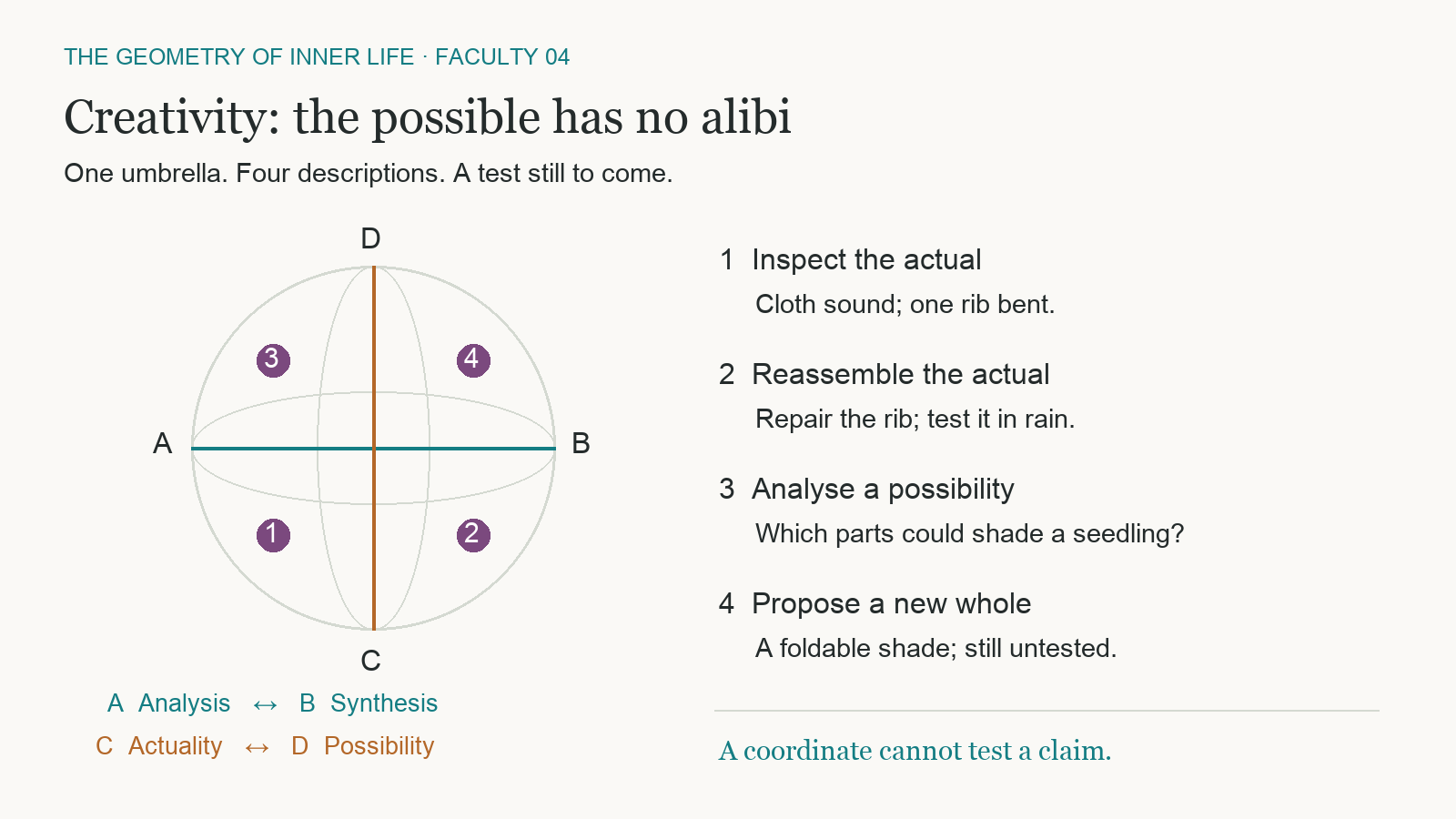
In Mo’s fictional account of Gariste Valois, creativity is one of eight faculties of synthesis. The novel does not supply its four poles. For this episode we propose two crossing relations: analysis ↔ synthesis for the movement of an inquiry, and actuality ↔ possibility for the status of what the inquiry describes. The result is a conceptual field, not a map of brain tissue or a measure of talent.
Four poles, two different questions
Analysis separates a thing into features, constraints or assumptions that can be inspected. Synthesis tries to compose relations into a working whole. These are operations, not opposing personality types. A serious maker moves repeatedly between them. You can synthesize a faithful repair and analyse a speculative design.
Actuality names what has been made, observed or demonstrated in the case at hand. Possibility names a proposal whose realization remains open. These are statuses of a particular account, not two substances in the world. “The umbrella has eight ribs” is an actual claim if we have counted them. “The ribs could support a small canopy” is a possibility until its constraints have been met and the canopy tried. An imagined shade may be physically possible and still be the wrong shade for a windy balcony.
Do not confuse our analysis/synthesis axis with Kant’s distinction between analytic and synthetic judgments in the Critique of Pure Reason. We use ordinary names for ways of handling a design problem. Kant’s distinction concerns the relation of a predicate to a concept and the conditions of knowledge; it cannot be transplanted onto this sphere by resemblance of words. [1]
Read the umbrella four ways
One, analytical and actual: the umbrella’s cloth is intact, its hinge moves, one rib is bent. This is an inventory. It may be accurate without being inventive, and it can stop a bad invention before it starts.
Two, synthetic and actual: after straightening the rib, we open the umbrella. It holds together in rain. The repair combines parts into a functioning whole. Its success is actual, although no new kind of shelter has appeared.
Three, analytical and possible: we ask which parts could perform another function. Could the cloth filter sunlight? Would the ribs hold a different angle? What would have to remain, and what could be cut? No seedling has yet been shaded. The value of this position is that it makes a proposal’s conditions visible before a charming sketch conceals them.
Four, synthetic and possible: we propose a foldable shade that uses the existing ribs and fabric, fixes to the planter without new plastic, and can survive an afternoon outdoors. This is a candidate design, not an achieved result. Moving it towards actuality requires a prototype, a test and perhaps an embarrassing revision.
The four positions are landmarks, not four species of people. A repair can be imaginative; a proposal can be derivative. A point near the centre might mark a rapid exchange between analysis and synthesis, or a description too vague to tell us which occurred. The coordinate needs a question and a reason attached. Two interpretations can occupy the same place while one is supported by a working prototype and the other by nothing more than a persuasive voice.
Kant’s warning to the original
In §§46–50 of the Critique of Judgment, Kant discusses genius in fine art. Originality matters, but mere novelty is insufficient: the work must also be exemplary, capable of serving as a model for judgment or further work. He also separates the making of art from a recipe that could simply be taught and repeated. [2]
This is an aesthetic argument, not a universal checklist for every useful invention. It still punctures a familiar boast. The gallery photograph of our umbrella may be original in presentation and empty in achievement. Equally, the modest repair may be valuable without becoming a Kantian work of genius. Novelty, use and aesthetic force require different arguments. Our sphere can register a proposed orientation; it cannot confer any of these prizes.
Bergson asks who stocked the cupboard
In “Le possible et le réel,” Bergson attacks the picture of future works waiting fully formed among pre-existing possibilities. His example of the great drama of tomorrow is sharp: if he already knew what the work would be, he could write it. Once created, it becomes easy to project its possibility backward, as though its exact shape had always been available for selection. [3]
Our second axis risks precisely the illusion he diagnoses. The possible end of our diagram must not be read as a warehouse of completed designs awaiting their turn. It marks descriptions we can now formulate under stated constraints. A genuinely new work may also change the vocabulary in which we describe the options. When that happens, the field must be revised. The map is accountable to creation; creation is not accountable to a fixed map.
Boden opens the space, then changes its rules
Margaret Boden distinguishes three ways AI techniques can help generate ideas: novel combinations of familiar elements, exploration within a conceptual space, and transformations that permit ideas previously excluded by that space’s rules. She notes that generating ideas is easier to model than evaluating them. [4] Our repaired umbrella, proposed shade and altered design rule make that distinction concrete, though they are our examples, not her taxonomy of umbrellas.
A limitation follows. If the rule “an umbrella must keep a person dry” is retained, a seedling shade looks like misuse. If the rule becomes “use these materials to regulate exposure,” a new path opens. A point moving within our sphere represents a revised description under a given frame. Changing the frame itself may demand a new field. The interface lets you change a constraint for this reason; it does not pretend that dragging a dot is the same thing as transforming a conceptual space.
A hypothesis is allowed to fail
Peirce’s account of abduction begins with a surprising fact and proposes a hypothesis that would make the fact intelligible if it were true. That is a reason to suspect the hypothesis, not to announce its confirmation. [5] Creative inquiry often has this provisional shape. The bent rib suggests an unexpected use; the idea earns further work by making consequences testable.
The shade might cast too much shadow. It might collapse in wind. It might shelter the wrong plant. Every failure is information about the candidate, not a verdict that imagination should have stayed at home. There is a difference between treating a conjecture as a conjecture and using the word “creative” as immunity from contact with the world.
What the playable field asks you to do
Open the interactive creativity field →
Choose a constraint, inspect the same umbrella, and move four proposed readings. The on-screen sphere lets you drag a point or rotate the view. Those actions are deliberately separate: a changed view is not a changed argument. Give a reason for each placement, or leave a reading unplaced when the axes hide what matters.
The exercise will not score your creativity, infer a cognitive style, or discover a neural coordinate. It asks whether an inventory, a repair, a possibility and a proposed new whole are being confused. It also lets two readings coincide. When they do, the attached reasons remain distinct.
Where creativity ends, and where it does not
Creativity borrows from memory to retrieve materials, from attention to notice a neglected feature, from intuition to propose a direction, and from language to state a rule. None of those loans makes the faculties interchangeable. Our local question is: how is a configuration proposed or made, and what would count as its realization?
Here is a counterexample to the sphere’s pride. A poet invents a form that changes what later readers can even recognize as a poem. We can say that something moved towards possibility and synthesis. We cannot specify its novelty from coordinates that were defined before the new form existed. Bergson’s objection and Boden’s transformational case meet at that edge. To represent the work faithfully, the atlas may have to learn new distinctions from it.
Back at the workbench, the umbrella remains stubbornly material. Its bent rib may invite invention; its cloth may refuse the wind. The gallery photograph may be brilliant art. The repair may keep someone dry. The shade may protect the seedlings. If we want to know which claim is true, the sphere will not save us from opening the door and looking outside.
Creativity deserves a better compliment than “anything is possible.” It deserves the harder courtesy of asking which possibility, under which conditions, and what would have to happen for us to say it has arrived.
Sources and scope
This is speculative epistemology developed from Mo and Gariste Valois in Marius Tianu’s The Apophatic Man. The four poles, coordinates and umbrella exercise are original proposals. They are not validated neuroscience, psychological measurements or claims that the cited thinkers endorsed this atlas. AI assistance contributed to research, drafting, editing and interactive design.
- Immanuel Kant, Critique of Pure Reason, Introduction IV–V, on analytic and synthetic judgments. This is cited to distinguish Kant’s technical terms from our processual axis.
- Immanuel Kant, Critique of Judgment, §§46–50, trans. J. H. Bernard (1892).
- Henri Bergson, “Le possible et le réel,” in La pensée et le mouvant (1934; essay first published 1930), especially the discussion of the future dramatic work and retrospective possibility.
- Margaret A. Boden, “Creativity and Artificial Intelligence,” Artificial Intelligence 103, nos. 1–2 (1998): 347–356, doi:10.1016/S0004-3702(98)00055-1. Claims here follow the publisher’s abstract.
- Charles S. Peirce, “Pragmatism and Abduction,” Collected Papers 5.189–190 (1903).
Previous faculty: Attention — What the Figure Lets You Overlook →

