Start with the introduction to the atlas →
THE GEOMETRY OF INNER LIFE · PART VII · LANGUAGE
One sentence can grant an exit, end an employment, or make a refusal impossible. The words have not changed. The relation has.
“You can go now.” The woman at the door says it softly. The sentence looks generous on paper. It has a subject, a modal verb, an action and a time. A grammarian could have it home before dinner. The person hearing it may not get home at all.
In one room it releases a guest from an obligation. In another it may dismiss an employee. Said by a guard to a prisoner, it may announce a genuine release or a trap. Said by a lover after an argument, it might mean “I will not stop you,” “I want you gone,” or “Please prove that you will stay.” The sentence does not carry all of these meanings simultaneously. Its use in a particular situation has to be investigated. But the same words can support each of them, and the difference can cost someone a home, a job, or a measure of dignity.
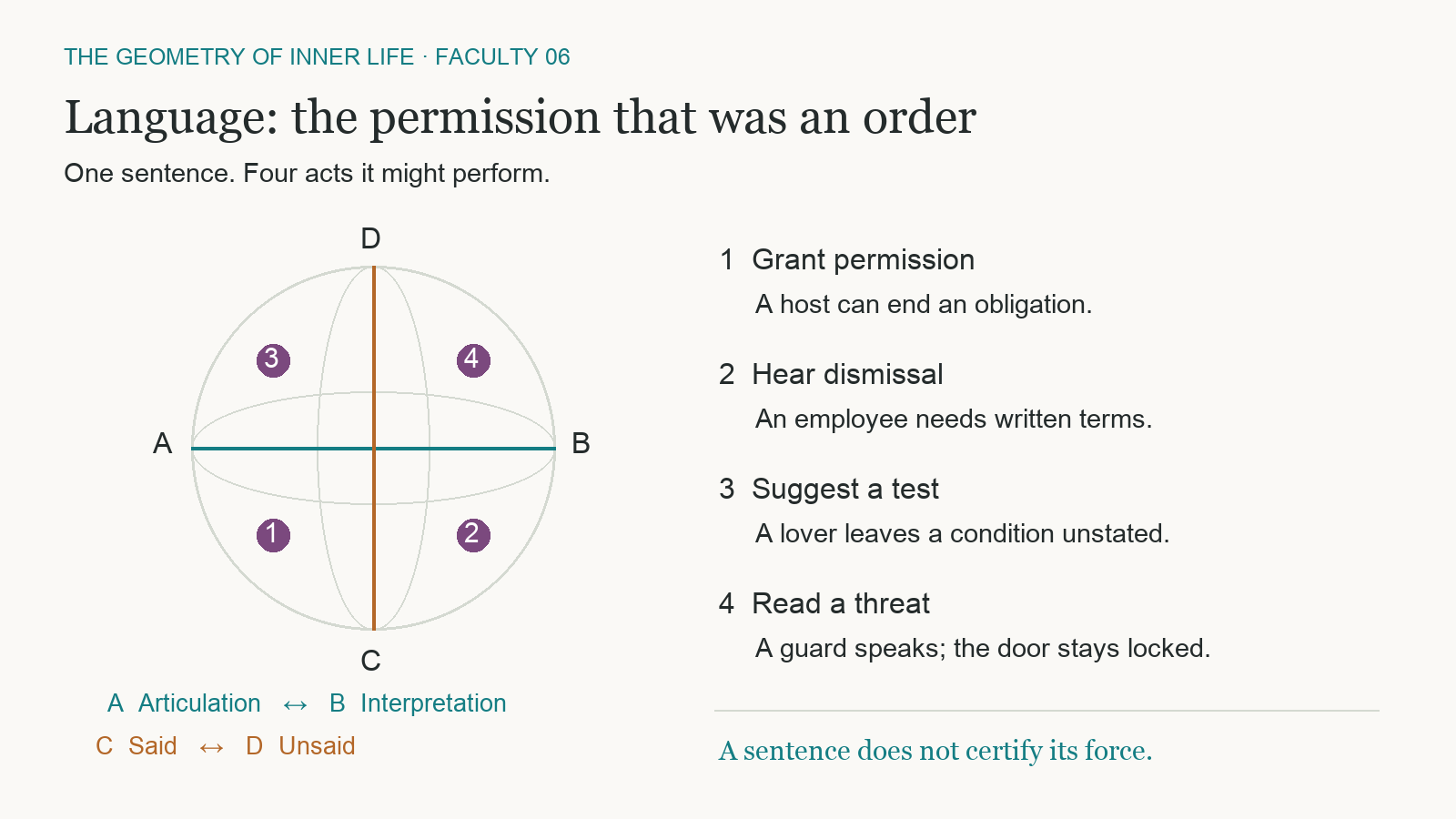
In the fictional science of Mo and Gariste Valois, language is one of eight faculties. Our series proposes two relations for it. The processual axis runs from articulation to interpretation: how an expression is made available and how it is taken up. The conceptual axis runs from said to unsaid: what the expression commits to openly and what its use lets a listener infer, suppresses, or leaves open. These are tools for reading a situation. They are not locations in the brain, measurements of mental state, or a theory credited to the philosophers cited below.
Four poles do not make a dictionary
Articulation includes choosing words, ordering them, addressing someone and performing a recognizable utterance. Interpretation includes identifying what act has been performed, what was referred to and what one is being asked or allowed to do. The two operations are coupled: a speaker anticipates an audience, and an audience can force a speaker to clarify. Yet they are not identical. I can utter a perfect sentence and fail to make a promise; you can infer a threat I deny having made.
The said is the publicly inspectable linguistic material and the commitments it can conventionally bear in that setting. The unsaid is not a mystical storage room behind language. It includes an implication left to the listener, a withheld condition, a relevant alternative never voiced, and sometimes an absence produced by fear. We must specify which sense we mean. A listener’s imaginative guess is not automatically the speaker’s implication; an omission is not automatically a secret intention.
Aristotle’s On Interpretation begins by relating spoken words, written marks and experiences of thought, then distinguishes isolated terms from combinations capable of truth and falsity. He gives us an early discipline: identify the level of what we are examining before judging it. But the sentence at the door is not exhausted by whether a proposition about someone’s ability to leave is true. That does not refute Aristotle. It shows that our question extends beyond the logical work he is doing there. [1]
Four readings of the same sentence
One, articulation toward the said: a host says, “You can go now,” after a guest has waited politely for the end of a ceremony. The words grant permission. To defend that reading, we need the prior obligation, the host’s standing to release it and the guest’s opportunity to leave. The bare sentence is not enough.
Two, interpretation toward the said: an employee hears the same sentence at the end of a disciplinary meeting. She understands it as an instruction to leave the room. A written notice may later decide whether her employment ended. Her interpretation is a serious piece of the event, but her hearing alone does not establish every institutional consequence.
Three, articulation toward the unsaid: after a quarrel, a partner utters the words while blocking neither the door nor the argument. A conditional demand may be suggested: if you leave, you will show what you really feel. That demand is a hypothesis about the use of the utterance; the partner can be asked, and later conduct may count for or against it. The convenient luxury of implication is that a speaker can try to make another person carry a burden never openly accepted.
Four, interpretation toward the unsaid: a prisoner hears the guard’s permission but waits. The guard has used the same words in a previous trick; the exit remains locked. What the prisoner interprets is partly a sentence, partly a history of power. Staying may be prudent without proving that this particular guard intended deception. A map that confuses vigilance with certainty has already begun to work for the guard.
These four readings are examples, not fixed quadrants of language. The host’s permission can become a dismissal when the guest learns why it was uttered. The employee can request a written clarification. The partner can answer the question that the sentence declined to ask. The prison door can open. A claim changes position when the reasons that support it change. Two interpretations may occupy the same plotted position while resting on radically different grounds. A coordinate is an index to an argument, never its substitute.
Austin: a sentence can do something
J. L. Austin’s How to Do Things with Words begins with performative utterances and goes on to a more general account of illocutionary force. The distinction matters here because “You can go now” can be used to grant permission, order departure or announce a release. These are acts made in speaking, not merely reports of a private thought. The right words can fail to do the intended act when the relevant circumstances or authority are missing. A stranger cannot release a prisoner by saying the same sentence through a wall. [2]
Austin does not hand us a sphere with four endpoints. His work gives our sphere a test: what act could this speaker perform here, and what would make it succeed or fail? That question keeps articulation from being treated as mere sound and interpretation from becoming a spectator’s free association. The sentence moves in a social practice with conditions that may be contested.
Grice: the unsaid has reasons
H. P. Grice distinguishes what is said from what a speaker implicates in conversation. His example of a bank employee who has not yet been to prison illustrates how an apparently factual sentence can suggest something its literal content does not state. Crucially, an implicature is not simply whatever a listener can imagine. It depends on assumptions about the exchange and a reconstruction of why this remark, here, was made. [3]
“You can go now” may imply “I want you to leave.” It may instead imply “You are safe to leave.” A listener may have excellent reasons to ask which, and sometimes no safe opportunity to ask. The geometrical temptation is to put every implication at the unsaid pole and call the work finished. Grice makes that impossible: we must show the inferential route. An unsaid content with no account of its production is merely a suspicion wearing a diagram.
Wittgenstein: move the sentence, change the game
In the Philosophical Investigations, Wittgenstein asks us to look at language games and the activities in which words are used. His list ranges across reporting, ordering, asking, joking and thanking. It undercuts the idea that a sentence’s philosophical role can be settled by reading its words in isolation. The host, employer, lover and guard are not four decorative contexts added to a stable core. What counts as permission or command depends on the practice in which the expression is used. [4]
Yet “meaning is use” is not a license to make a word mean anything anyone wants. Practices have learned expectations and correctable misunderstandings. The guest can ask whether the ceremony is over; the employee can ask whether she is fired. The answer may be evasive, and the evasion itself will then become part of what is happening.
What writing does to the door
Now put the sentence in a text message: You can go now. The sender is absent when it is read; the place, time and addressee can change. Jacques Derrida argues in “Signature Event Context” that a written mark must be repeatable beyond the immediate presence of its producer and recipient, and that no context can be exhaustively closed around it. His argument is more radical than the mild claim that texts are sometimes ambiguous. We need not accept every consequence of it to see the problem it raises for our map: the same string can survive the scene that once constrained it. [5]
Forward the message to a third person and it may become evidence, a joke, a warning, or an accusation. The axis from articulation to interpretation remains useful, but the distance is historical as well as conversational. The sphere can display an interpretation’s present emphasis; it cannot store every prior circulation of the sign. For that, the point needs a record of its journey.
Try the sentence yourself
Open the interactive language field →
In the playable field, change who says the sentence and ask what evidence would settle the act. Move the four readings. Rotate the sphere to inspect the geometry without changing the evidence. Put two readings at one coordinate and compare their reasons. Leave one unplaced if neither axis captures what matters. The field invites revision; it does not diagnose your linguistic competence or reveal an author’s hidden intention.
The counterexample: when permission has no force
Imagine the guard says, “You can go now,” but a locked door and an armed colleague remain between the prisoner and the street. Is this a permission, a threat, a test of obedience, or a sentence whose ordinary act has been disabled? The four poles let us describe words, uptake and things left unsaid. They do not by themselves explain the institution that gives one person a key and another no credible right to refuse. Rae Langton’s analysis of speech acts and silencing presses us to examine how social power can affect what people are able to do with words. Her argument is not this atlas’s theory, and our prison example does not reproduce her case. It exposes a related limit: a formally available utterance need not be an effectively available act. [6]
There is a second failure. A person unable to speak may gesture toward the exit; another may understand. If we define language only as articulated words, the episode excludes communication it needs to explain. If we enlarge articulation to every meaningful gesture, the boundary between language, action and empathy becomes an open philosophical question. Our atlas should record that pressure rather than win by changing its definition quietly.
The host’s guest eventually leaves. The employee asks for written terms. The prisoner waits until the door is opened. The lover says, “Do you want me to go?” Four sensible actions, none computable from six words alone. The sentence had the decency to be short. We are the ones who expected it to be innocent.
Sources and scope
This essay extends the fictional epistemological atlas associated with Mo and Gariste Valois in Marius Tianu’s The Apophatic Man. The two axes, four readings and interactive positions are this series’ interpretive proposals. They are not validated neuroscience, a psychological assessment or positions attributed to the authors below. AI assistance contributed to research, drafting, editing and interactive design.
- Aristotle, On Interpretation, chapter 1, in The Works of Aristotle, trans. E. M. Edghill. Cited for the relation of speech, writing and thought and for the role of combination in truth and falsity.
- J. L. Austin, How to Do Things with Words, 2nd ed. (Oxford University Press, 1975), lectures I–III and VIII–XII. The book moves beyond a simple performative/constative opposition.
- H. P. Grice, “Logic and Conversation” (1975), in Syntax and Semantics 3, 41–58, especially the opening discussion of implicature.
- Ludwig Wittgenstein, Philosophical Investigations, §§2, 7, 23 and 43. The linked scholarly Nachlass displays the German original; its machine-generated English is for orientation only and is not quoted here.
- Jacques Derrida, “Signature Event Context” (1971), translated in Margins of Philosophy, pp. 307–330, especially the discussion of absence, repeatability and context.
- Rae Langton, “Speech Acts and Unspeakable Acts”, Philosophy & Public Affairs 22, no. 4 (1993). Cited for the problem of speech acts under unequal power, not as support for this diagram.
Previous faculty: Memory — The Past Does Not Testify →

