Start with the introduction to the atlas →
THE GEOMETRY OF INNER LIFE · PART VI · MEMORY
The photograph is certain of the platform. You are certain of the farewell. Neither has told us which train was leaving.
There is a photograph in a family envelope: your father on a railway platform, wearing the coat he wore for years. Your sister says it was the day he went away. You say it was the day he came back. The date stamped on the print is legible. The back is blank. A photograph can be an excellent witness to a coat and an incompetent witness to a goodbye.
Both of you remember the cold. That agreement feels promising until you learn that the station had no roof. You may remember the same afternoon, or the same story told for twenty years. You may even remember the photograph. A mind is not obliged to announce which of these services it is providing.
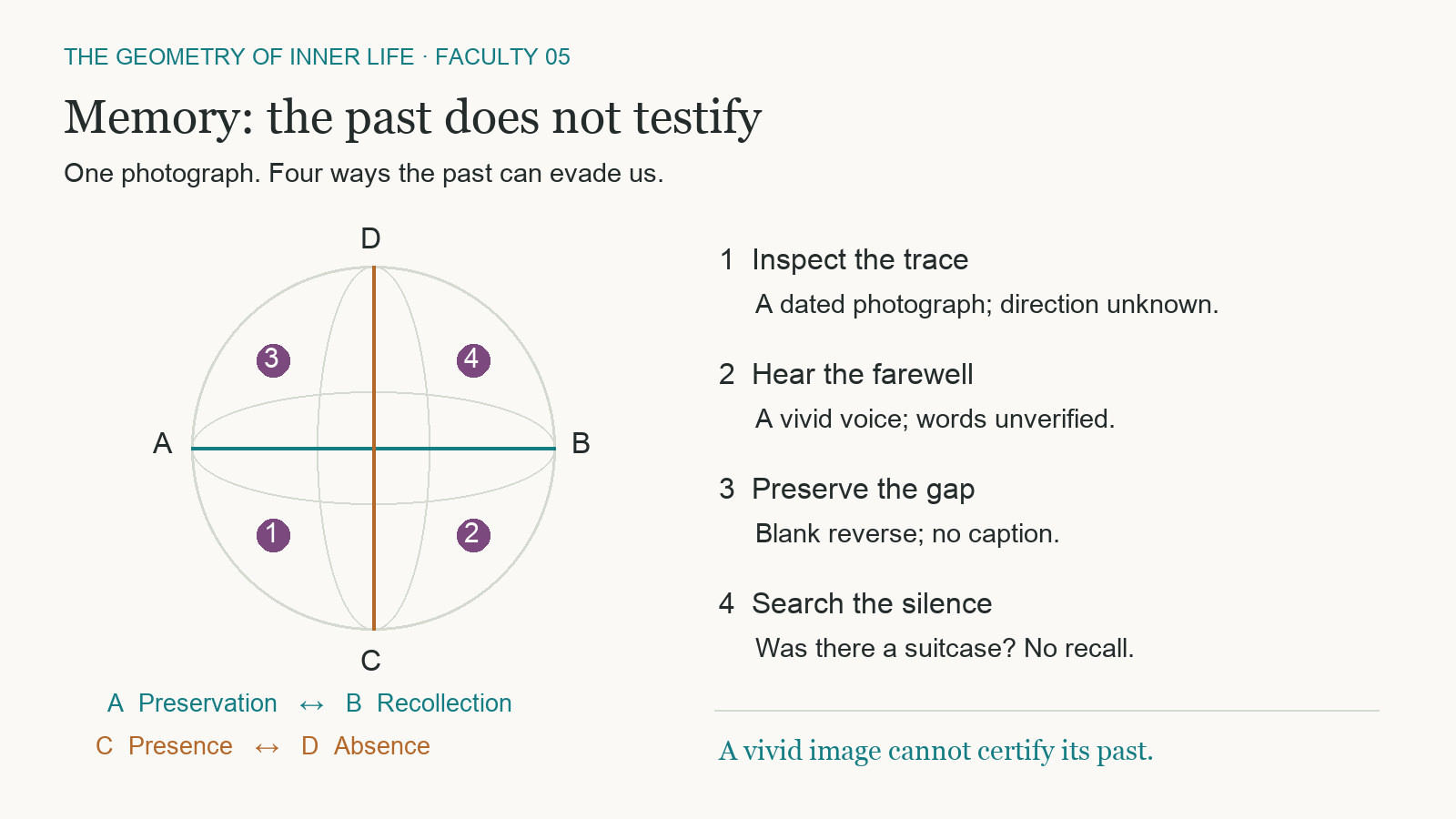
In Mo’s fictional account of Gariste Valois, memory is one of eight faculties. The introductory atlas proposes two relations for it: preservation ↔ recollection, a processual question about what remains available and what is actively sought; and presence ↔ absence, a conceptual question about what the present encounter supplies and what it withholds. These are interpretive directions, not anatomical coordinates, tests of memory ability, or claims that a photographed past has physically returned.
Four poles, no time machine
Preservation names the persistence of a trace: a photograph, a sentence in a diary, a learned gesture, or a disposition that can later be drawn upon. Recollection names the activity of trying to bring a past event to mind. A preserved trace need not be a personal memory; a recollection need not recover an intact record. The poles mark where a description places its emphasis. They do not describe two sealed compartments in a brain.
Presence here means what is available to a present act of inquiry: a visible print, a remembered scene, a voice one seems to hear again. Absence means what that act cannot supply: the unrecorded direction of the train, the words no one can recover, the father who is no longer on the platform. A vivid image may be present as an image while its alleged event remains uncertain. If we mistake one kind of presence for another, nostalgia receives the privileges of evidence.
Aristotle gives the first warning. In On Memory and Reminiscence, memory concerns what is past, while recollection involves a search. He asks how a present image can be of something absent, using the analogy of a picture seen both as a thing in itself and as a likeness of something else. The distinction is sharper than the convenient phrase “I can see it perfectly.” What is seen perfectly may be the present image. The remembered object is another matter. [1]
Four readings of one envelope
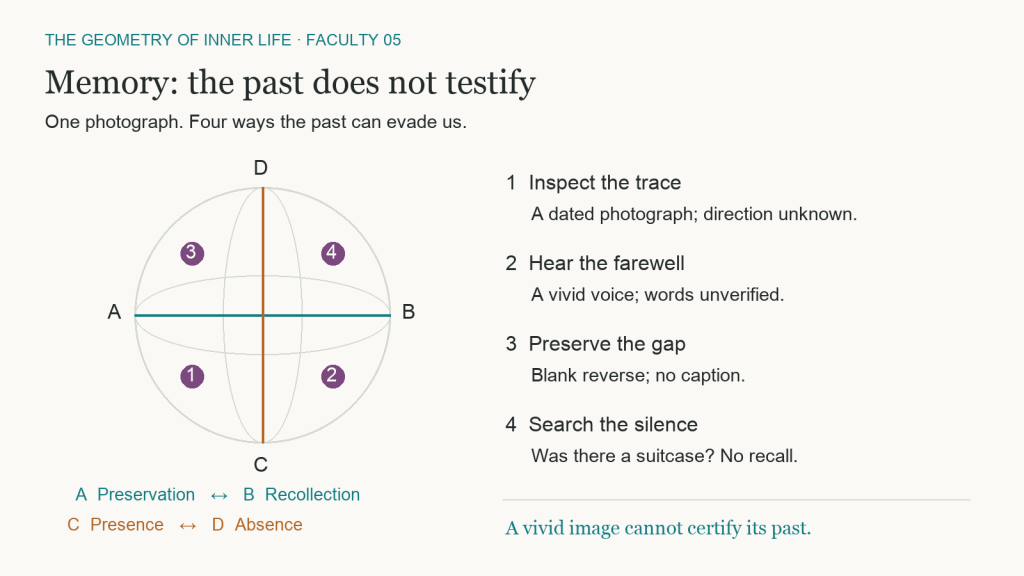
One, preservation toward presence: the photograph survives; its date and visible details can be inspected together. We can compare the coat, the platform and the print with other records. We cannot infer the direction of the train from the father’s posture. A trace can be present and still be silent on the question we care about.
Two, recollection toward presence: your sister says she can hear the farewell. Her experience has force for her. It may direct us toward a letter or another witness, but vividness does not independently certify the words. The image’s presence in consciousness and the event’s historical accuracy must be argued separately.
Three, preservation toward absence: the reverse of the print contains no caption. The absence is a feature of this record, not proof that nobody wrote, spoke or knew. We can preserve a gap by declining to fill it with a plausible story. A blank space is sometimes the most honest part of an archive.
Four, recollection toward absence: you try to recall whether your father carried a suitcase and cannot. The failure may be yours, the original event may not have contained a suitcase, or the detail may never have been noticed. “I do not remember” is a statement about present access, not a universal claim about the past.
The four readings can migrate. A newly found letter may move the inquiry toward a preserved and present trace. It may also make the sister’s recollection seem less certain or call forth a detail neither of you had mentioned. Two accounts may occupy the same coordinate with different grounds: one voice is supported by a dated letter; the other by a story repeated at every family dinner. The dot cannot adjudicate between them. Its attached reasons must do that work.
Locke’s person cannot fit in the envelope
In An Essay Concerning Human Understanding, II.xxvii, Locke makes continuity of consciousness central to personal identity and asks what follows when parts of a life cannot be remembered. He also calls “person” a forensic term, one tied to the appropriation of actions and accountability. His argument concerns what makes a person the same person across time; it does not say that a family photograph verifies a recollection. [2]
Yet his question enters this envelope. If the farewell is forgotten, did you cease to be the child who stood there? Ordinary life resists such a verdict. So does responsibility: forgetting a promise is not normally a way of cancelling it. The atlas can locate a failure of recollection without deciding the metaphysics of identity or the justice of blame. It must not smuggle a theory of the person into a diagram of access to the past.
Bergson’s past is not a weak photograph
In Matter and Memory, Bergson distinguishes pure memory, memory-images and perception while arguing that actual experience interweaves them. His account does not treat recollection as simply a pale copy of present perception; the present’s demands help determine what becomes available for action. [3]
Your sister’s image may return because this dispute asks for it. That does not prove the image was manufactured by the dispute, nor that it lay unchanged in storage. Bergson gives us a philosophical account of the movement between past and present, not a laboratory method for authenticating one family scene. He is also an awkward guest in our neat geometry: a process in motion cannot be captured by four stationary corners. The drawing is useful only if it lets a reading move.
What the experiment and the family add
Frederic Bartlett’s Remembering examines how people reproduce material over time, including the well-known “War of the Ghosts” retellings. His cases show omissions and transformations in the studied reproductions. They challenge the easy assumption that recalling a story is equivalent to replaying a recording. They do not license the slogan that every recollection is false, or a prediction about what these two siblings in particular will say. [4]
Maurice Halbwachs, in Les cadres sociaux de la mémoire, asks how social settings give shape to what individuals can remember. A family has its own prompts, approved versions and silences. The story told at dinner may help a child keep hold of a past; it may also teach the child which ending is welcome. Social framing need not make every memory a committee decision. It does mean that “I remember” may carry a plural history of rehearsals. [5]
Endel Tulving’s distinction between episodic and semantic memory provides another restraint. Knowing that your father once left by train is not the same as remembering being there. His later account of autonoetic consciousness concerns the felt relation to one’s own subjective past. We can use those distinctions without pretending that the four poles above are Tulving’s systems, or that the feeling of mental time travel settles the photograph’s date. [6]
Try the archive before choosing a winner
Open the interactive memory field →
The playable field gives you the same photograph, two sibling accounts and a blank reverse. Reveal one additional clue at a time. Move the four readings on the sphere, or leave one unplaced. Rotate the view without changing the claim. The separation matters: changing an angle on a screen is not changing evidence, and changing evidence does not move every interpretation in the same way.
Then ask what would count against your preferred story. A dated ticket might show that a journey occurred without proving whether this image was departure or return. A letter might identify the occasion but not recover the father’s exact words. An honest inquiry can become more precise while staying undecided.
The counterexample the map must admit
Suppose a family has deliberately destroyed the letter that would have identified the day. The missing trace is not an innocent blank. Preservation and recollection can still describe what we do, but presence and absence do not tell us who produced the absence, or why. The map needs a history of custody, power and motive. Halbwachs’s social question cannot be reduced to a new coordinate inside a private head.
There is a second failure. Some forms of remembering are practical: you find your way home or play a tune without picturing an earlier journey or performance. Bergson’s discussion of habit and Tulving’s distinctions both warn against identifying the whole of memory with a narrated episode. A sphere designed around a family photograph cannot claim to exhaust the faculty. It can show where this inquiry stands and where its own frame ends.
Perhaps your father was leaving. Perhaps he was arriving. Perhaps the photograph belonged to another journey and both of you have been borrowing its platform for a real farewell that happened elsewhere. The envelope does not owe you a verdict. Neither does your conviction. Memory deserves the harder courtesy of asking what survives, what is being sought, what is present now, and what remains absent even after the story has become beautiful.
Sources and scope
This episode extends the fictional epistemological atlas associated with Mo and Gariste Valois in Marius Tianu’s The Apophatic Man. The two axes are proposed in the series introduction; the family scene, four readings and interactive coordinates are interpretive constructions. They are not validated neuroscience, diagnostic instruments, or positions attributed to the cited authors. AI assistance contributed to research, drafting, editing and interactive design.
- Aristotle, On Memory and Reminiscence, Parts 1–2, trans. J. I. Beare. Cited for pastness, image-as-likeness and active recollection; its ancient physiology is not adopted.
- John Locke, An Essay Concerning Human Understanding, Book II, chapter xxvii, especially §§9–10, 20 and 26.
- Henri Bergson, Matter and Memory (1911 English translation), chapter III, on pure memory, memory-image, perception and action.
- Frederic C. Bartlett, Remembering: A Study in Experimental and Social Psychology (Cambridge University Press, 1932), chapter V, “Experiments on Remembering.”
- Maurice Halbwachs, Les cadres sociaux de la mémoire (1925), especially the preface and chapters on the family.
- Endel Tulving, “Episodic and Semantic Memory,” in Organization of Memory (1972), pp. 381–403, discussed in his 1987 author commentary; and “Memory and Consciousness,” Canadian Psychology 26 (1985): 1–12. His categories are not the axes of this atlas.
Previous faculty: Creativity — The Possible Has No Alibi →

