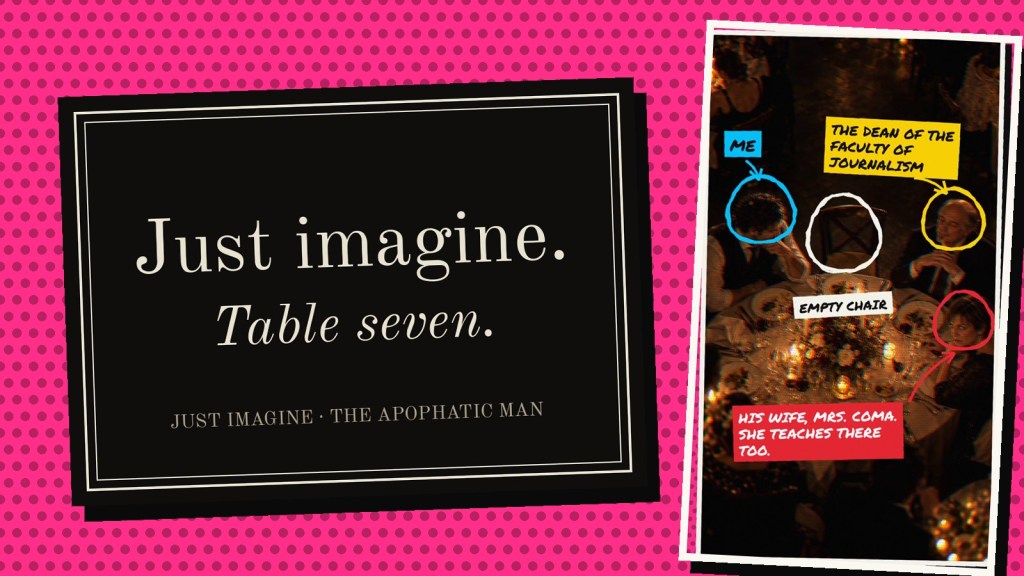
JUST IMAGINE · TABLE SEVEN
The liquor was dreadful, the band was murdering a ballad, and the Dean of the Faculty of Journalism wanted my opinion. His wife was sitting right next to him.
Just imagine that you are seated at table seven of a wedding you had every intention of missing. The liquor is dreadful. The band is murdering a ballad. On your left, an empty chair. Beyond it, the Dean of the Faculty of Journalism. Beyond him, his wife, who teaches at the same faculty.
Now imagine the dean leans across the empty chair and asks what you think of his faculty.
I didn’t have to imagine it. I was there.
The worst seat in the house
My parents had never learned to refuse an invitation, however tenuous their acquaintance with the host. Sciatica had struck the family at the worst possible moment, and I had been drafted to represent the Jebeleanus, a responsibility I regard as a particularly vindictive form of filial duty. Worse, it had obliged me to abandon another engagement, one promising better liquor, better music, and women of considerably more frivolous disposition.
Instead: table seven. Myself, an empty chair, the dean, his wife, and two other couples whose names I had neglected to retain.
The liquor was dreadful, depriving me of the one reliable means of enduring an evening among people determined to enjoy themselves. All that remained was ill temper. I met every attempt at conversation with a monosyllable, occasionally two when the occasion demanded exceptional generosity.
“Not much.”
“What do you think of the Faculty of Journalism?”
“Not much.”
Nicolas Coma was a kindly man, so constitutionally inoffensive that I doubted he had ever inspired a strong emotion in anyone, himself included. My answer disappointed him, though not sufficiently to abandon the conversation. He confessed he had only started talking to me because I looked bored, in the hope of a conversation that went nowhere and an excuse to go home early. Now, he said, I had left him no choice but to defend his honor.
A laugh erupted beside me. It was a dark, viscous laugh, dredged from some subterranean reservoir of malice, with enough mud in it to suggest that Hell had recently experienced heavy rainfall.
“Honor? What honor? And if you insist on defending it, darling, I do hope you’ll use live ammunition.”
Meet Professor Chris Coma: the dean’s wife and head of the Communication Department at the same faculty. If her husband was good-natured, she was good by no conceivable definition of the word. She was the sort of woman who could fail an entire class because she had arrived two hours late for an examination and one of the students had been foolish enough to mention it.
The lecture nobody ordered
So I told the dean what was wrong with his faculty. That it was still teaching journalism as though it were 1965. That every one of his lectures began with a warning, do not confuse the journalistic genres, and that a generation raised on memes, disinformation and thirty-second attention spans hears in such a warning only a man who has somehow managed to miss the last half-century while remaining professionally employed throughout it.
As I spoke, I privately replaced each learned expression with the filthiest equivalent I could summon. What emerged instead was a perfectly respectable discussion of intertextuality and the production of meaning in media discourse. I was becoming so academically presentable that I began to disgust myself.
“And you think you could do better?”
His wife again. The fury she was struggling to contain had turned her into an induction coil. Her short, straight hair seemed to stand at right angles to her skull, and her eyes had acquired a metallic gleam. I decided to exercise restraint. Turning my back on her, I addressed the dean.
The most dangerous sentence of the evening
The dean appeared either miraculously immune or irreparably blind to his wife’s fury. With perfect serenity, he said:
“I like Chris’s idea. What do you say? Would you be interested in teaching?”
I felt obliged to clarify a point. “Your wife’s question was ironic. A rather volatile mixture of irony, frustration, and the barely suppressed desire to emasculate me.”
“Mine isn’t.”
At this point I introduced the table to a rarely used and almost criminally neglected word: pusillanimity. That peculiarly masculine paralysis induced by the sight of a woman undergoing a massive nervous discharge. At such moments, any man with a properly developed survival instinct knows that the wisest course is to soil his underwear, just a little.
Chris opened her mouth, emitted a peculiar little yelp, then leaned toward me and announced in a shrill falsetto: “Jokes! The refuge of weak minds!”
“You should know that, in my case, making jokes is the intellectual equivalent of playing dead. Is it working?”
It was not. She turned to her husband as though I had ceased to exist.
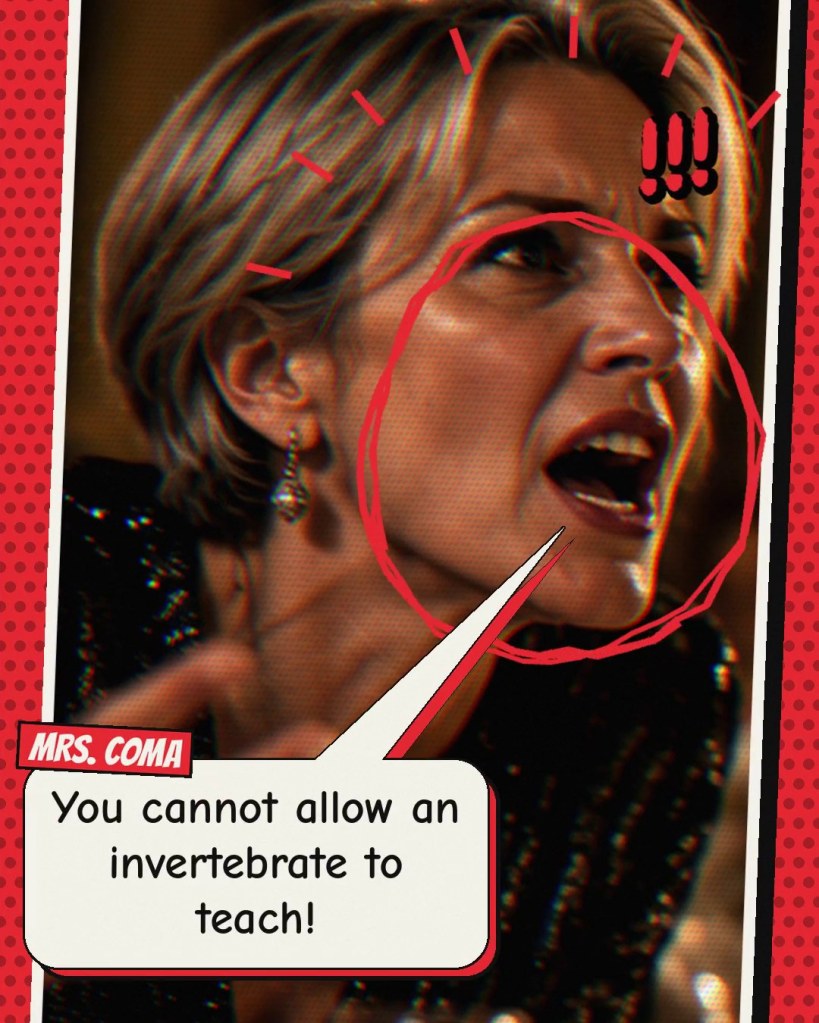
“You cannot allow an invertebrate to teach. Can’t you see? This man’s conceit is the size of a metastasis. Let him into our faculty and he’ll destroy us.”
Four words and a knife
To my surprise, her anger had extinguished mine. I turned toward her and spoke quietly.
“Teaching journalism better than you do would hardly qualify as an achievement.”
Then I told her the four qualities I consider indispensable to journalism, precisely the ones her institution was least equipped to teach. Revolt. Irreverence. The ability to form a coherent point of view. And a vocation for the absurd.
Revolt. A journalist who has made his peace with the world is about as useful as a fire alarm that approves of smoke. Serenity is admirable in monks, houseplants, and the recently deceased. In a reporter, it’s a professional disability.
Chris shifted in her chair. Her knife struck the edge of her plate with a sharp, accidental note. Her husband glanced at the cutlery, then at her, with the mild concern of a man who had heard a familiar noise coming from an unreliable household appliance.
Irreverence. Not rudeness. Any idiot can be rude, and most idiots regard it as a personal achievement. Irreverence is the disciplined refusal to be impressed.
A point of view. A journalist without one is not necessarily impartial. He may simply have nothing to say. And what you have then isn’t journalism. It’s an opinion wearing a laboratory coat.
Behind us, the band launched into a sentimental ballad. The singer was murdering the melody with such confidence that I briefly considered inviting him to join the Faculty of Journalism. He possessed all the necessary qualifications: an impressive voice, a complete absence of self-doubt, and no detectable relationship with the material.
A vocation for the absurd. A journalist who cannot recognize the absurd will describe a collapsing bridge as an infrastructure challenge, a theft as an accounting irregularity, and a national humiliation as an opportunity for dialogue. He’ll become the perfect graduate: a man who can explain everything except what is actually happening.
A waiter approached our table with a bottle of wine. He took in the dean’s attentive expression, his wife’s murderous stillness, and the peculiar silence of the remaining guests, and executed a discreet about-face. A sensible young man. With instincts like those, he would never make a journalist.
“And that, Professor, is why I think I could teach journalism better than you. Not because I know more. I probably don’t. But because I have no intention of teaching students to admire the world as it is. I’d rather teach them to recognize the moment when it becomes intolerable.”
Transnistria
The dean, who seemed supernaturally incapable of taking offense, proposed a title for my course. “Deontology and investigative journalism.”
I told him I would consider teaching. If I could choose the subject myself.
“You’re actually going to do this?” Chris was on her feet before the last word had left her mouth. Her chair scraped across the floor with a noise that briefly defeated the band.
We shook hands anyway. She was already marching toward the exit, and she did not bother to lower her voice.
“If you have a stroke tonight, you’re going straight into a nursing home. In Transnistria.”
He followed her with the serene haste of a man who had spent his entire married life learning that obedience and survival were not quite the same thing.
I eventually drank enough to forget the entire conversation. Two days later, an unfamiliar number appeared on my phone. “Mr. Jebeleanu, I hope you haven’t forgotten our arrangement.”
A man should be allowed to make extravagant promises under the influence of alcohol without being subjected to the indignity of having them remembered.
What happened next
About three hundred students turned up for the course, which was the first problem. You can read how it ended here. The whole evening is in chapter twelve of The Apophatic Man.
Homework
Have you ever told the truth at the wrong table? Tell me in the comments. Names optional. Consequences mandatory.
— A.J.
Andrei Jebeleanu is the editor-in-chief at the center of The Apophatic Man, a novel by Marius Tianu. Volume I is out on 10 November. Pre-order it on Amazon →

