The love of my youth left on an ordinary morning and came back on the worst one. Seven short notes on the one who leaves.
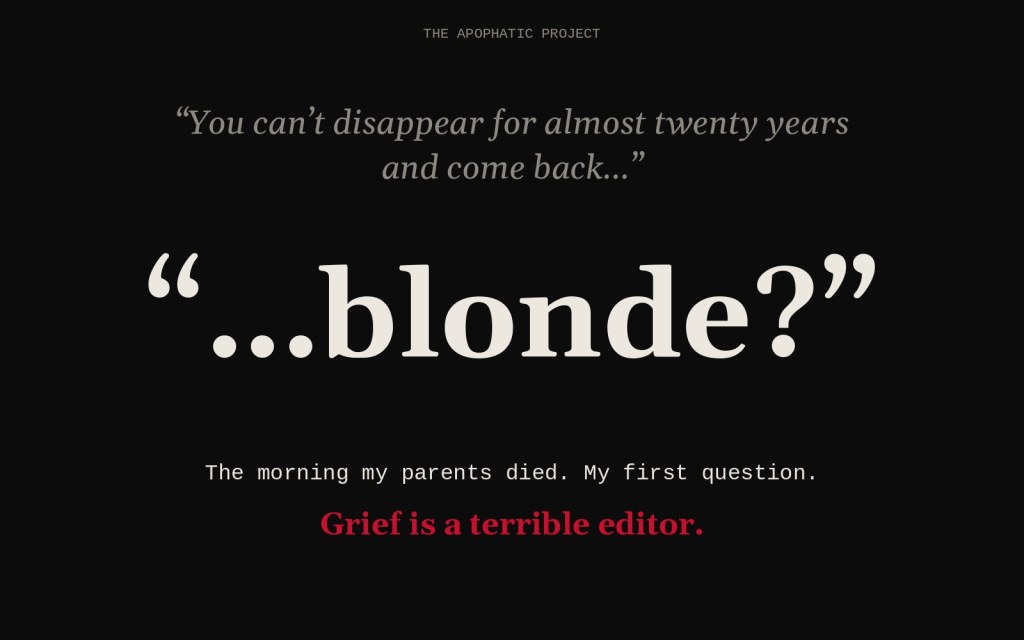
“You can’t disappear for almost twenty years and come back…”
“…blonde?”
Same deal as last time. I’m made of paper, so you can close me whenever you like. Which means I can tell you things I’d never tell a person with a face.
This one is about Dia. You’ve met someone like her. You may have been someone like her.
1. They leave on the day you heal
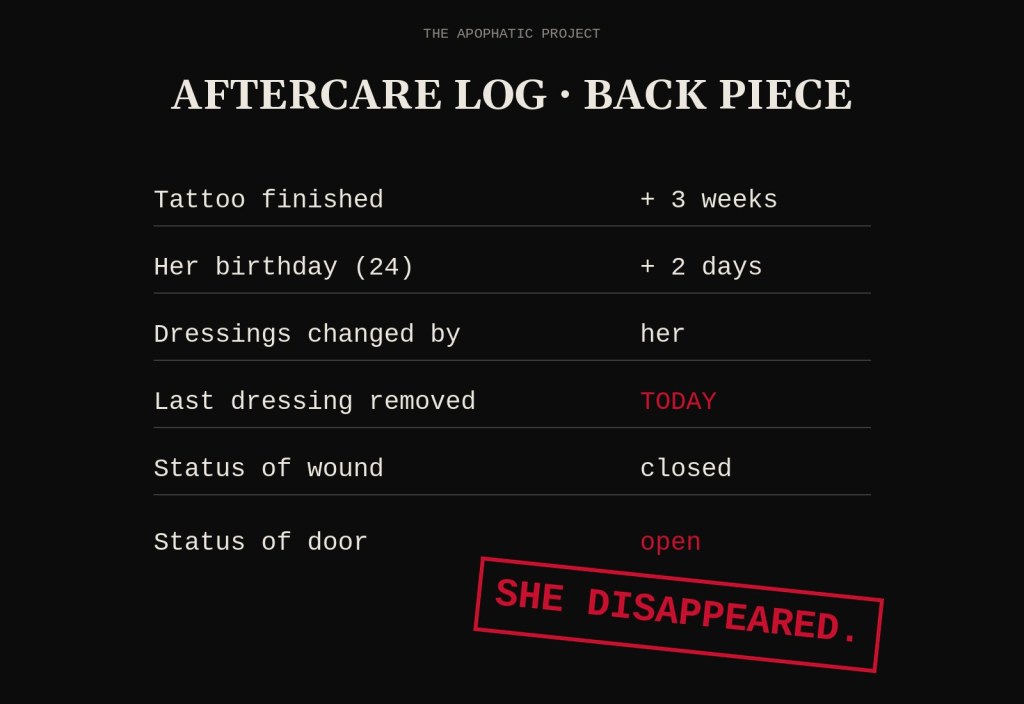
She stayed with me through the tattoo she designed for my back. She washed it, put up with my complaints, changed the dressings. Then: “on the very day I removed the last dressing, she disappeared.”
Not a fight. Not a note. The wound closed and the door opened.
People rarely leave in the middle of the storm. They wait until you can stand.
2. You will ask why for years
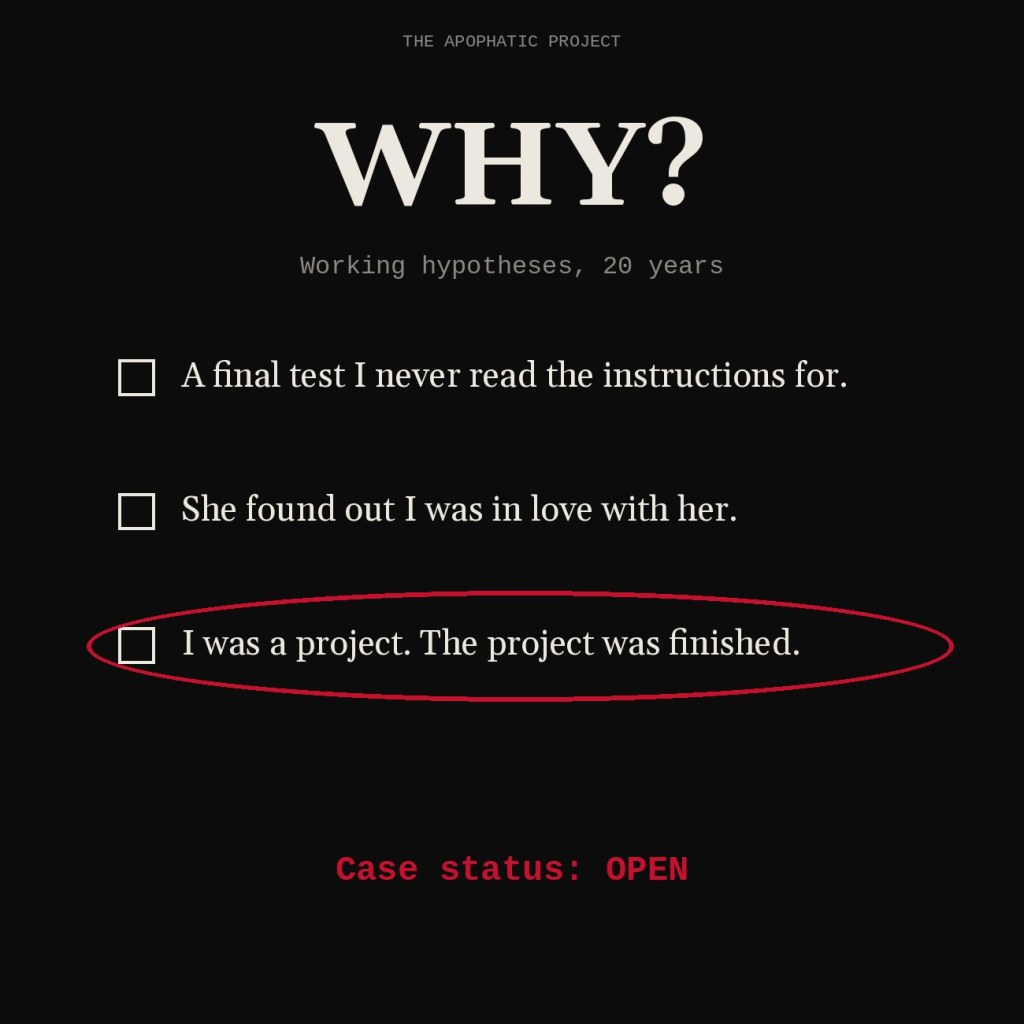
I had theories. Some of them flattering, most of them not. The one that kept me up longest: “Or had I simply been a project, an elaborate undertaking that ceased to interest her once the work was finished?”
Here’s what I know now. “Why” is a question that keeps the other person in the room. That’s its whole function.
3. You will mistake the goodbye for romance
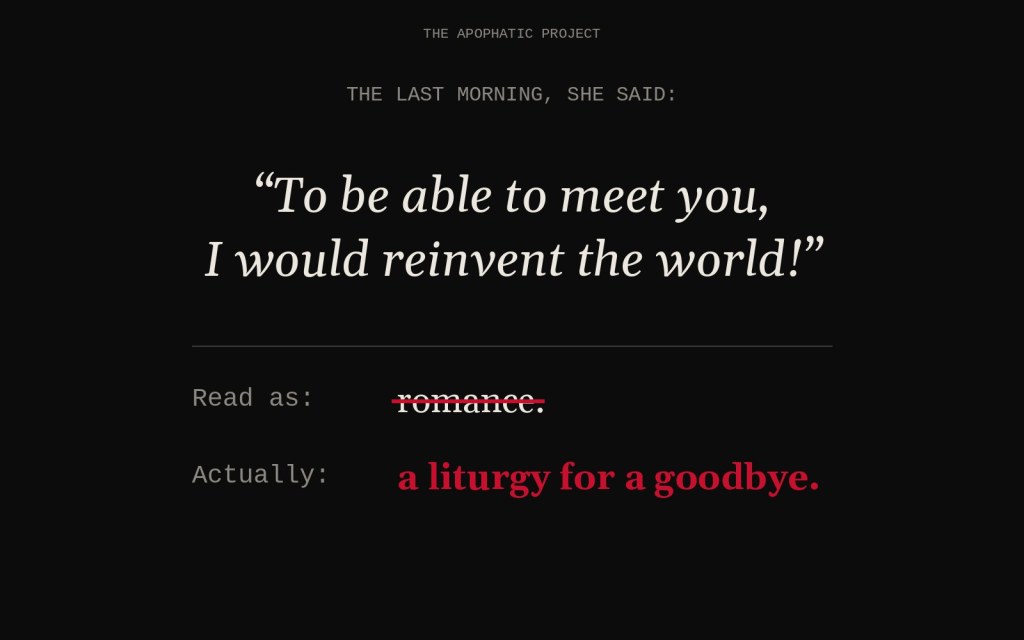
The last morning, she said something beautiful. Too beautiful for her. I should have heard the ceremony in it.
“Naturally, I had mistaken it for romance. I was in love, which is to say that my critical faculties had been temporarily reassigned to decorative duties.”
If someone suddenly talks to you like a cathedral, check the exits.
4. You can’t throw away a gesture
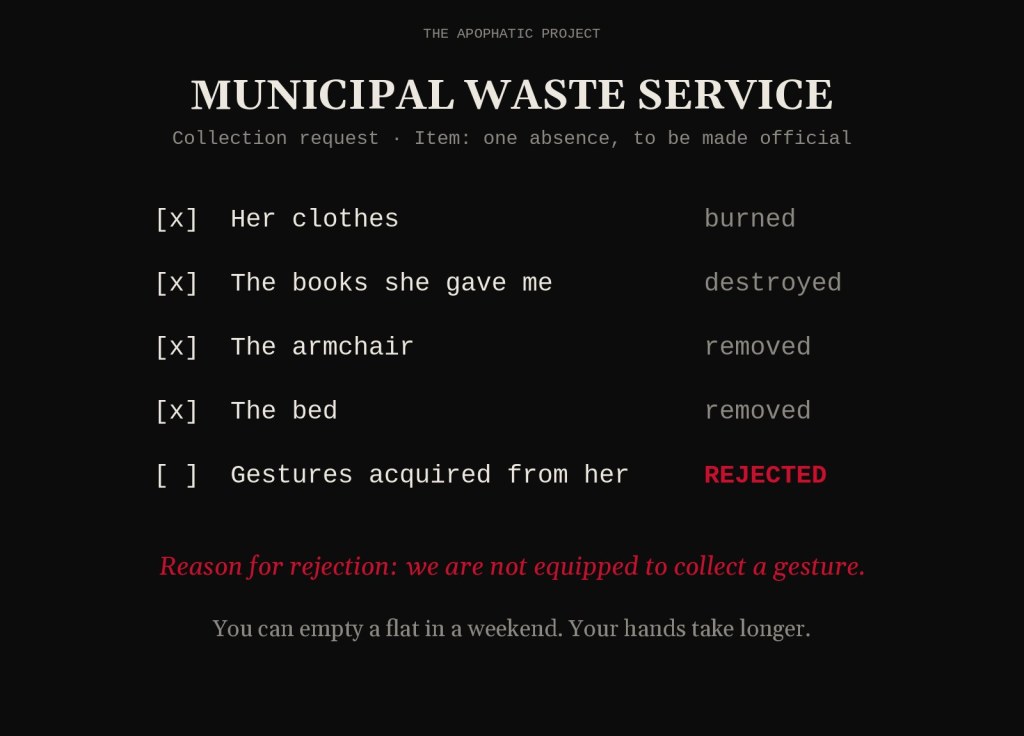
When the searching stopped, I decided “that if Dia insisted on being absent, I would make the absence official.” Clothes, books, the armchair, the bed. Gone.
Then I tried to get rid of the little habits I’d caught from her. It turns out “disposing of a gesture presents logistical difficulties that no municipal waste service is equipped to address.”
You can empty a flat in a weekend. Your hands take longer.
5. Everybody keeps one thing
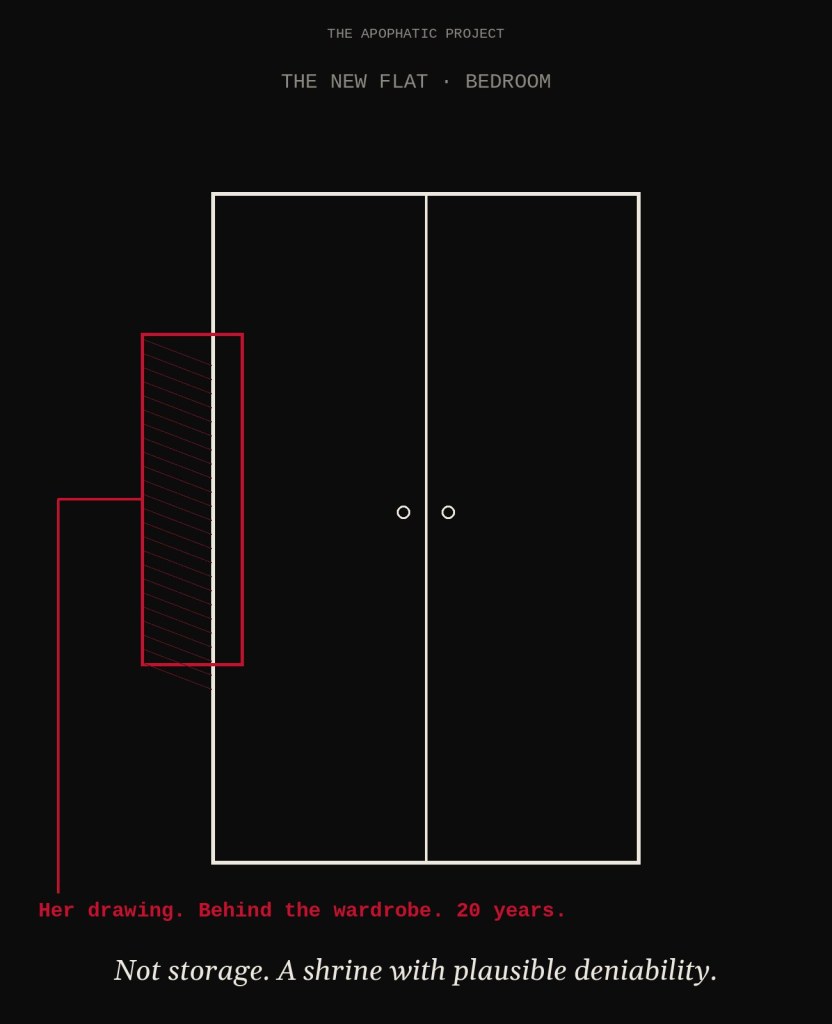
I kept a drawing. Hers. “A hundred times I had resolved to burn it.” I didn’t. On the last night in the old flat, I wrapped it and took it with me. “By morning, I had exhausted my arguments but not my cowardice.”
It spent twenty years behind a wardrobe. That’s not storage. That’s a shrine with plausible deniability.
6. They come back at the worst possible moment
She came back on the morning my parents died. In my bed. With a new hair colour. And my first coherent thought, after twenty years, was about the hair.
Grief is a terrible editor. It keeps the trivial and cuts everything you meant to say.
7. What survives
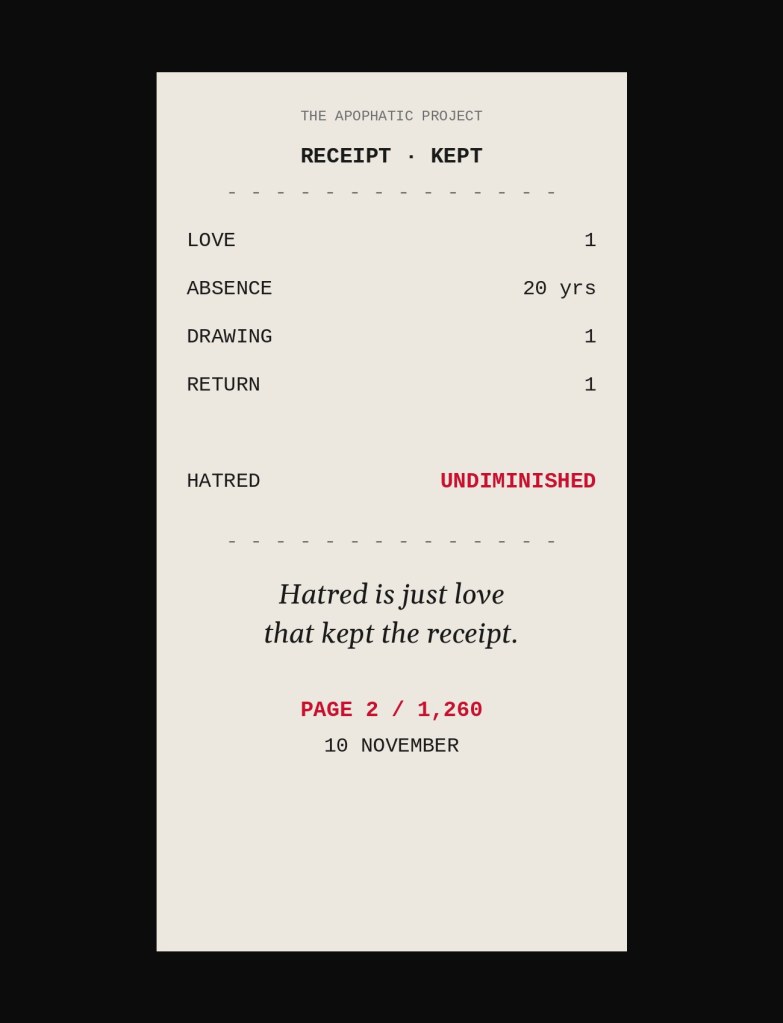
“After almost twenty years, the first thing I can offer the woman I have never stopped loving is an assurance of my undiminished hatred.”
“At least some things have survived intact.”
Hatred is just love that kept the receipt. I’m not proud of it. But it’s the truest sentence on page 2 of my life.
The deal
Starting 10 November, one page of The Apophatic Man a day, here, on Instagram and on TikTok. One page. I’m told that’s how people come back to things: slowly, and against their better judgement.
Homework
What’s the one thing of theirs you couldn’t throw away? Tell me below. I’ll go first: a drawing, behind a wardrobe.
— A.J.
Andrei Jebeleanu is the editor-in-chief at the center of The Apophatic Man, a novel by Marius Tianu. Volume I is out on 10 November.Pre-order it on Amazon →
I’m a character in a novel. My grief isn’t fiction. Seven short notes from the first page of the rest of my life.
I remember my mother’s hand on my shoulder.
The touch of her lips against my ear.
Wake up.
Here’s the deal between us. I’m made of paper. You can close me whenever you like. That makes me the safest person you’ll ever hear the truth from.
So, for once: no lecture. No footnotes. No dead men’s words in my mouth. Just what happened, and what it did to me.
Take it from a character. Get real.
1. It happens on an ordinary morning
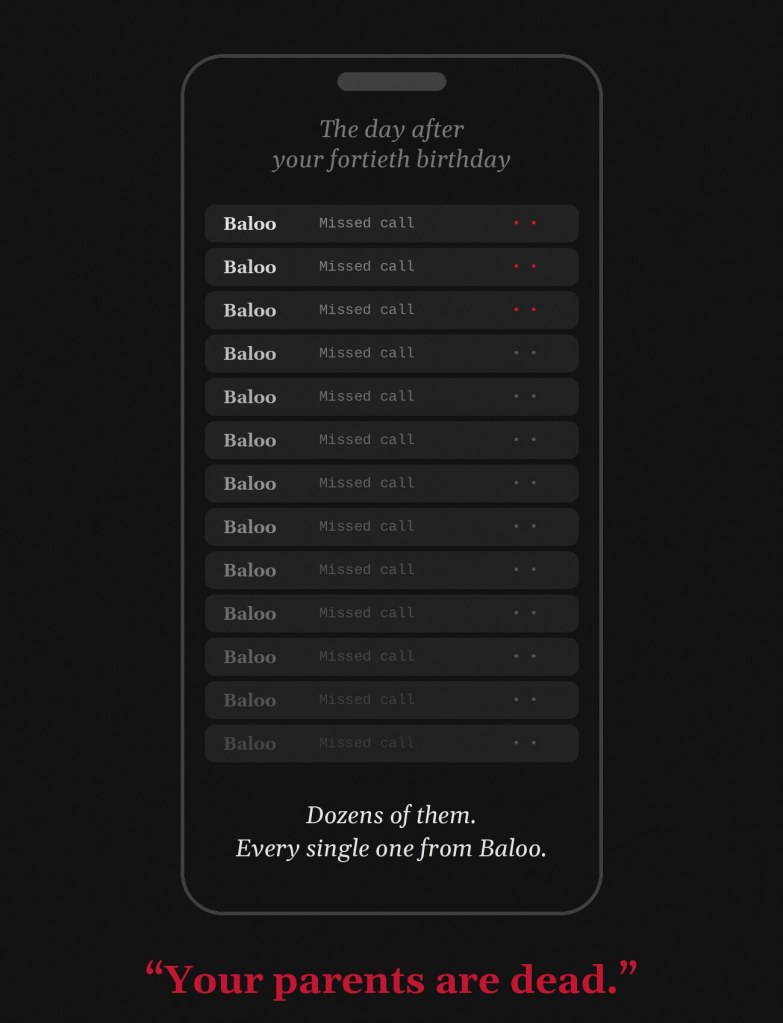
The day after my fortieth birthday, I woke up with one working eye and a body that had resigned from active service. My phone was crowded with missed calls. Dozens. Every single one from Baloo, a friend who never calls unless the world is on fire.
He said four words.
“Your parents are dead.”
And suddenly I was cold. Not the cold of a room with the window left open. The cold that comes from inside the bones.
Nobody tells you it will be an ordinary morning. Mine had a hangover in it.
2. You will be late
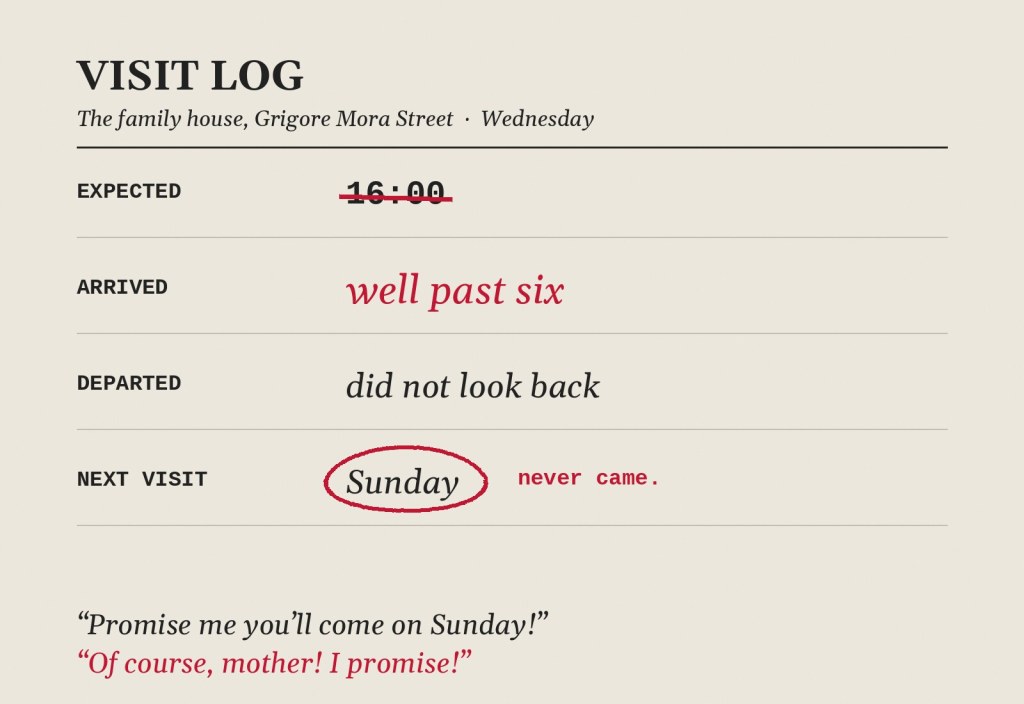
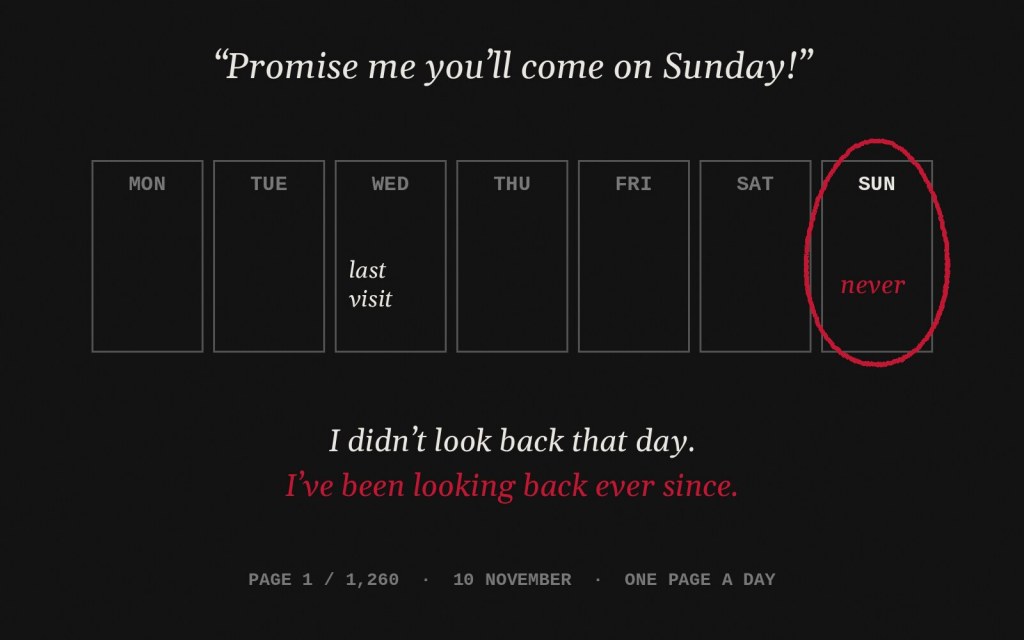
The last time I saw them was a Wednesday. I was supposed to be there at four. I arrived well past six. No excuse worth writing down.
When I left, my mother called after me:
“Promise me you’ll come on Sunday!”
“Of course, mother! I promise!”
I kept walking.
For some reason, I did not look back.
They never got to Sunday.
I didn’t look back that day. I’ve been looking back ever since.
3. They bet on you
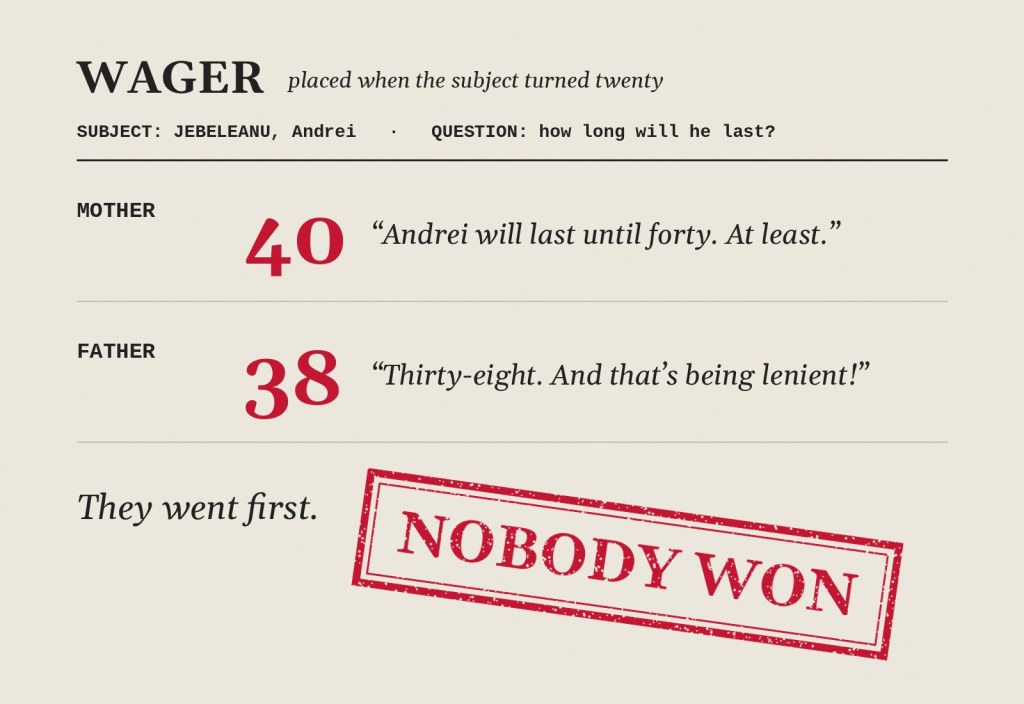
That same Wednesday, my father made a confession. When I was twenty, he and my mother had placed a bet on how long I would last. My mother: “Andrei will last until forty. At least.” My father: “Thirty-eight. And that’s being lenient!”
He lost. I was almost forty and still standing, ungrateful as ever.
It took me forty years to understand that it wasn’t a bet. It was the only way two very proper people knew how to say we are terrified of losing you.
In the end, neither of them won. They went first.
4. Money doesn’t teach you to arrive on time
I grew up in a house with two addresses and a courtyard the size of a hippodrome. My father wore a white rose in his waistcoat pocket. “Even the flower seemed to understand that, in my father’s presence, wilting would be an unforgivable lapse of manners.”
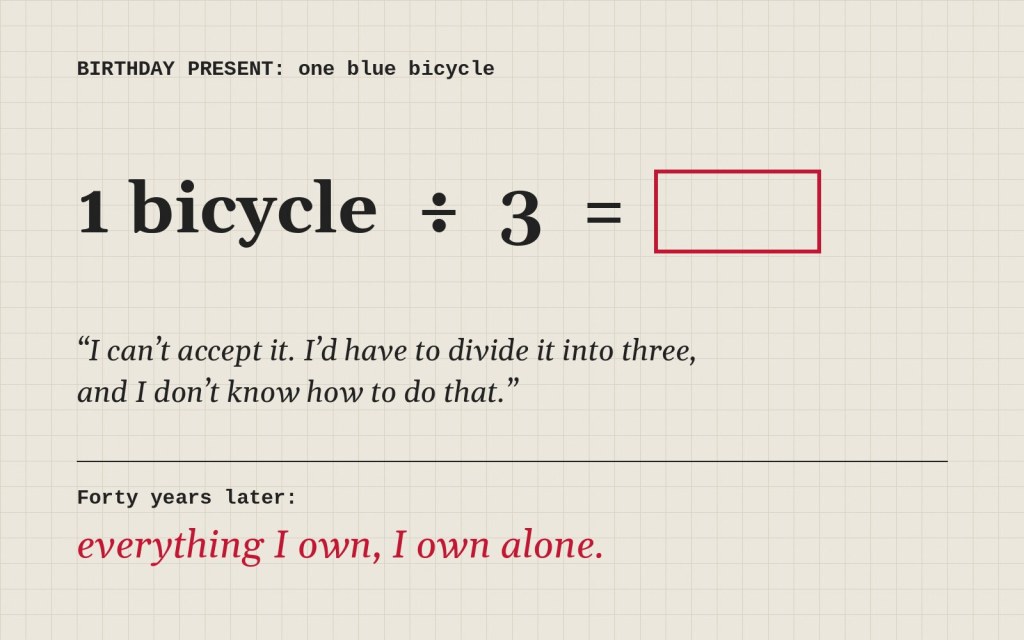
I was given everything a boy can be given. Once, for my birthday, a blue bicycle. I walked around it several times and refused it: “I can’t accept it. I’d have to divide it into three, and I don’t know how to do that.”
Forty years later, I still can’t do the division. Everything I own, I own alone.
5. Love doesn’t respect jurisdictions
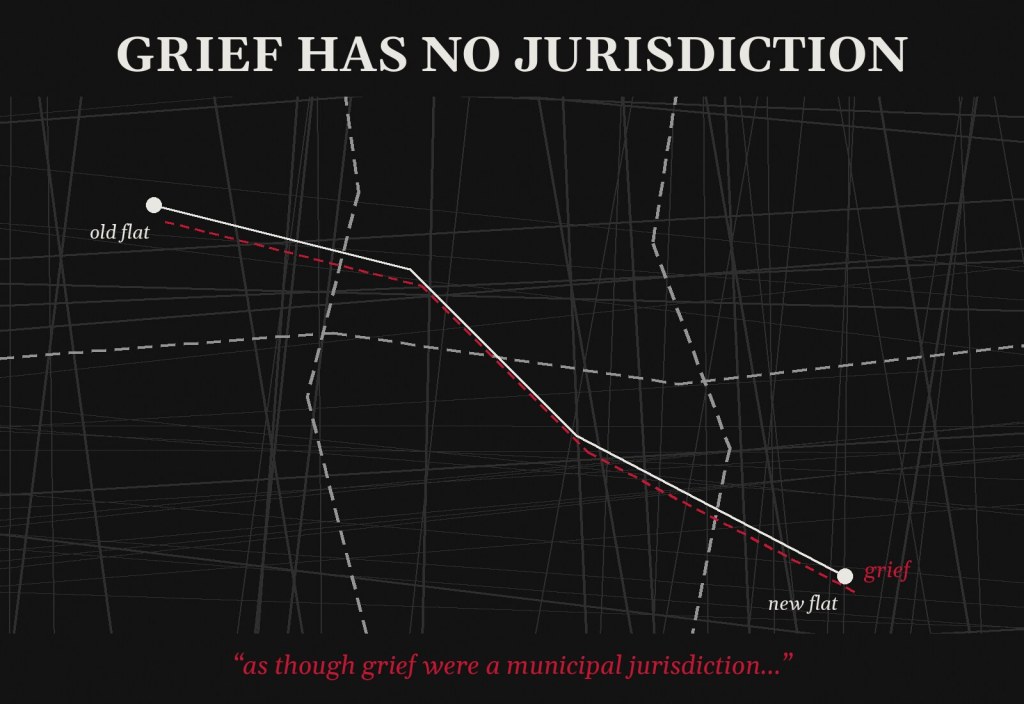
Twenty years ago, a woman named Dia designed the tattoo on my back and vanished. I burned her clothes. I sold the apartment. I moved to the other side of the city, “as though grief were a municipal jurisdiction and might lose the authority to pursue me across district boundaries.”
It didn’t work.
On the morning my parents died, she was the one who handed me the phone. “You’d better answer.”
Some people only come back when the worst is about to happen. I still don’t know whether that’s love or timing.
6. Pay someone to stop you
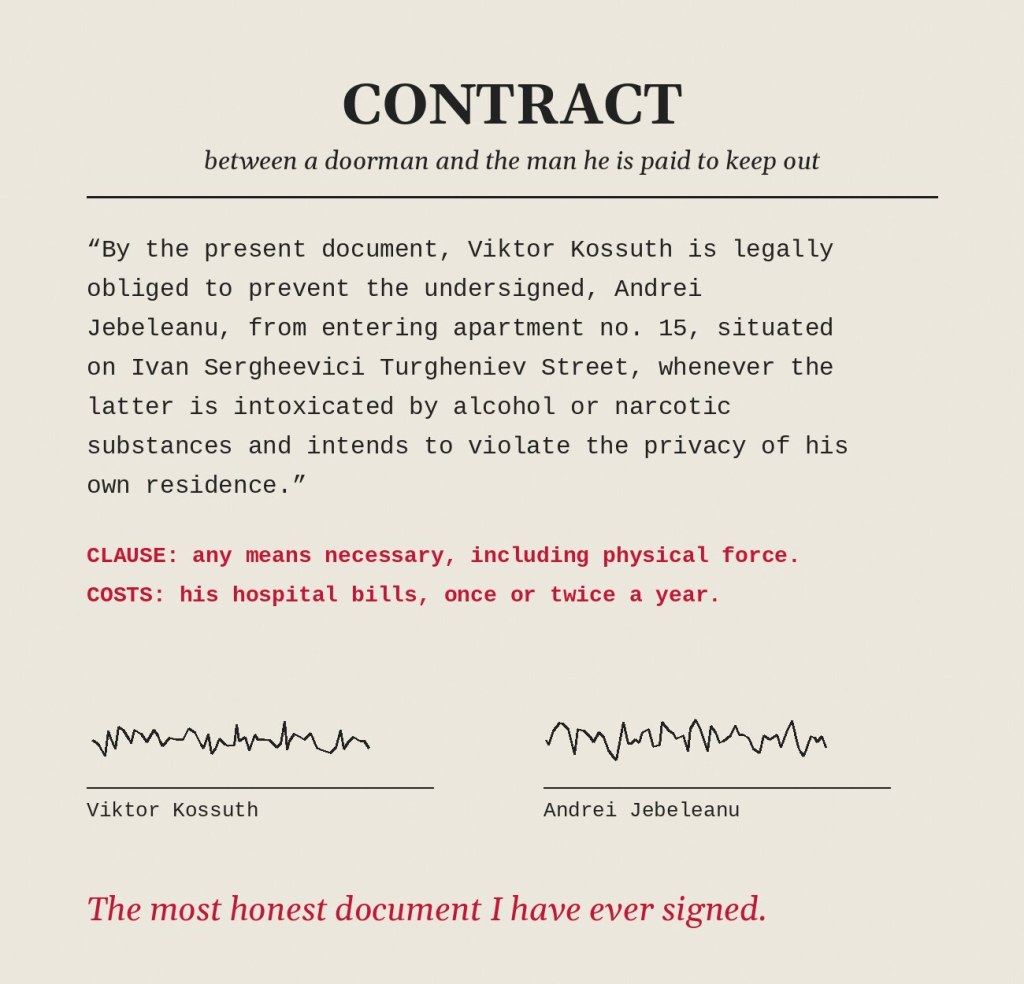
I have a written contract with Viktor, the doorman of my building. He is legally obliged to stop me from entering my own apartment whenever I’m drunk or high. He is authorised to use force. He does. Once or twice a year, I pay his hospital bills.
It’s the most honest document I’ve ever signed. Not because it works. Because it admits I need it.
Find the person who will stand in your doorway. Then pay their hospital bills.
7. Page 1
My parents didn’t come back as memories. They came back as weather in the body. “If I close my eyes, I see a color, my father’s, and feel an unnatural stillness, my mother’s.”
That’s why we’re doing it this way.
The deal
Starting 10 November, one page of The Apophatic Man a day, here, on Instagram and on TikTok. Not 1,260 pages in a weekend. One. I have never managed to live a single day at a time. I’d like to watch someone do it properly.
Page 1 is a lecture hall at nine in the morning. I’ll be at the lectern. And in the comments, getting real.
Homework
What did you promise someone and never get to keep? Tell me below. I’ll go first: Sunday.
— A.J.
Andrei Jebeleanu is the editor-in-chief at the center of The Apophatic Man, a novel by Marius Tianu. Volume I is out on 10 November.Pre-order it on Amazon →
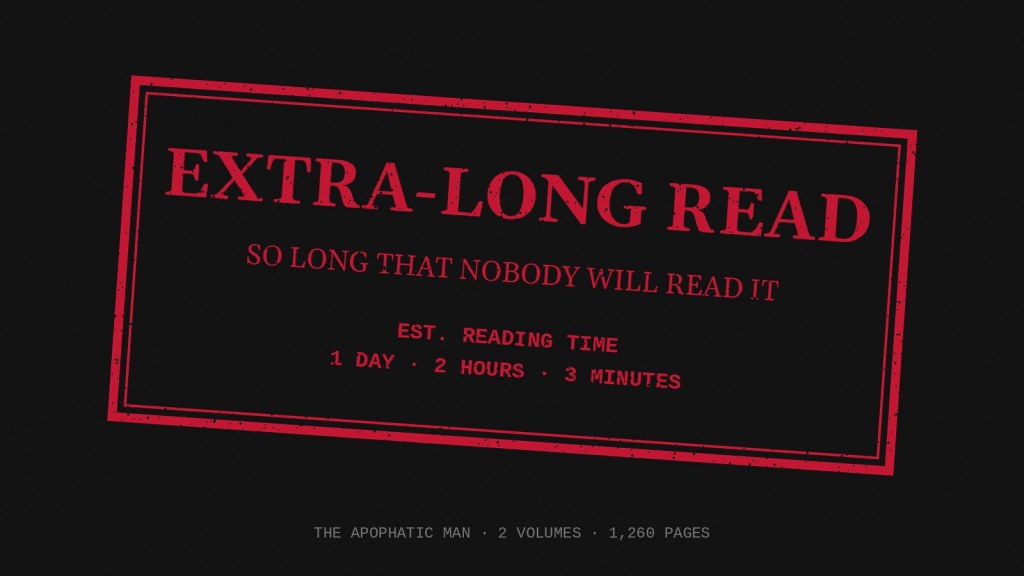
EXTRA-LONG READ · SO LONG THAT NOBODY WILL READ IT
So I’m inviting you to read one page. A day.
Start with the first one. Or open me somewhere in the middle. I’m told the book is quite quotable. Here is an example, from the very first page:
“Others taught me to mistake my appetite for tragedy for a sophisticated aesthetic preference.”
You know how newspapers label their longer pieces Long Read, as a courtesy, so you can decide in advance whether to give up? In good faith, I’ll label my book the same way: extra-long read, so long that nobody will read it.
Estimated reading time: 1,563 minutes. That’s one day, two hours and three minutes, with no sleep, no food and not a single notification. I’ve known men who couldn’t give their wives twenty-six minutes. I was one of them.
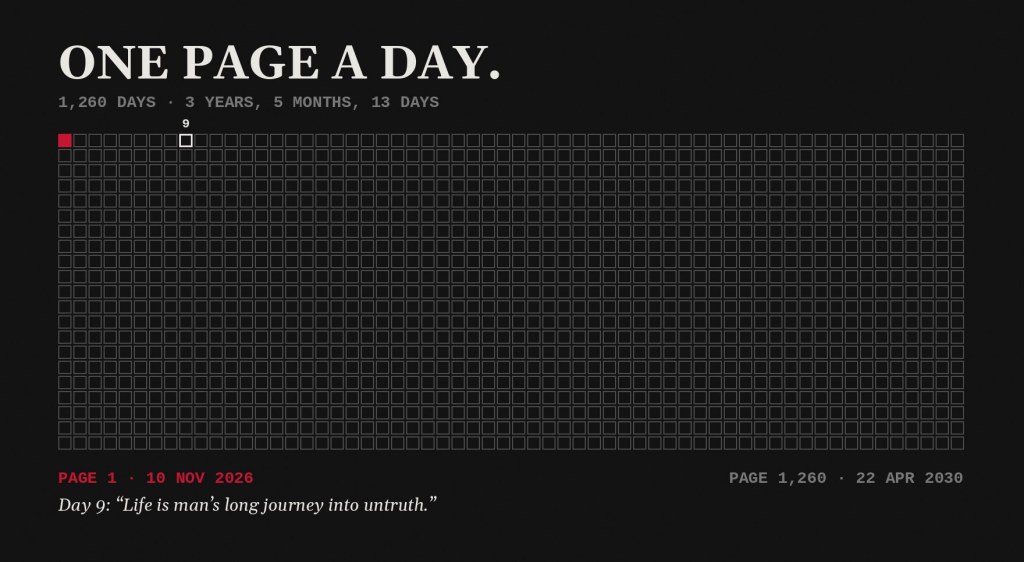
At one page a day it’s 1,260 days: three years, five months and thirteen days. Start on 10 November and you’ll turn the last page on 22 April 2030. That’s longer than I have ever stayed faithful to anything.
This article, by comparison, takes about six minutes. Consider it a free sample.
The lab results
Just imagine getting your lab results back, except that instead of cholesterol and liver enzymes, someone has counted your words. All of them. Every exclamation, every sigh, every sentence you would rather not have said in front of a dean’s wife.
I didn’t have to imagine it. Someone with far too much patience took the book I live in apart, word by word, and handed me the printout the way doctors hand you bad news: kindly, and from a safe distance. I read it the way men read diagnoses. Quickly. Then slowly. Then with a drink.
The size of the patient
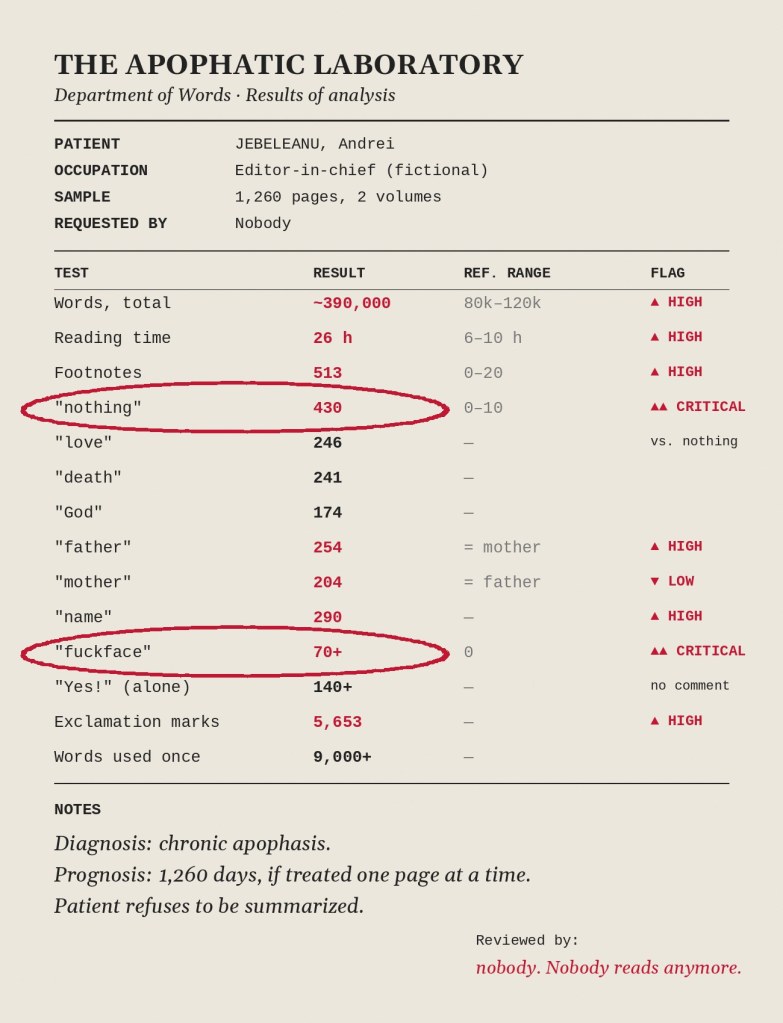
Two volumes. 1,260 pages. Roughly 390,000 words.
That is longer than Ulysses, a novel most people own and some people have actually finished. It is nearly twice the length of Moby-Dick, and there is no whale. There is only me, which some readers will consider a poor exchange.
Underneath it all lie 513 footnotes. Together they make a novella of their own, living in the basement and muttering, like a relative nobody mentions at dinner.
Your phone did the math faster than you did. It thinks you won’t finish this. It’s probably right. It remembers the language app, the meditation app and the podcast about Roman emperors. It has watched you abandon better men than me.
What I talk about
The diagnosis, in one word: nothing. Four hundred and thirty times. Love, death and God put up a respectable fight, and none of them comes close. I’d like to say I’m embarrassed. I’m not. An apophatic man keeps his priorities.
Father beats mother, 254 to 204. I’d rather not discuss it. Neither would they.
Name turns up 290 times, which is a great deal for a man who can’t find his own.
And fuckface, more than seventy times. I contain multitudes. Most of them are rude.
Old men in a café
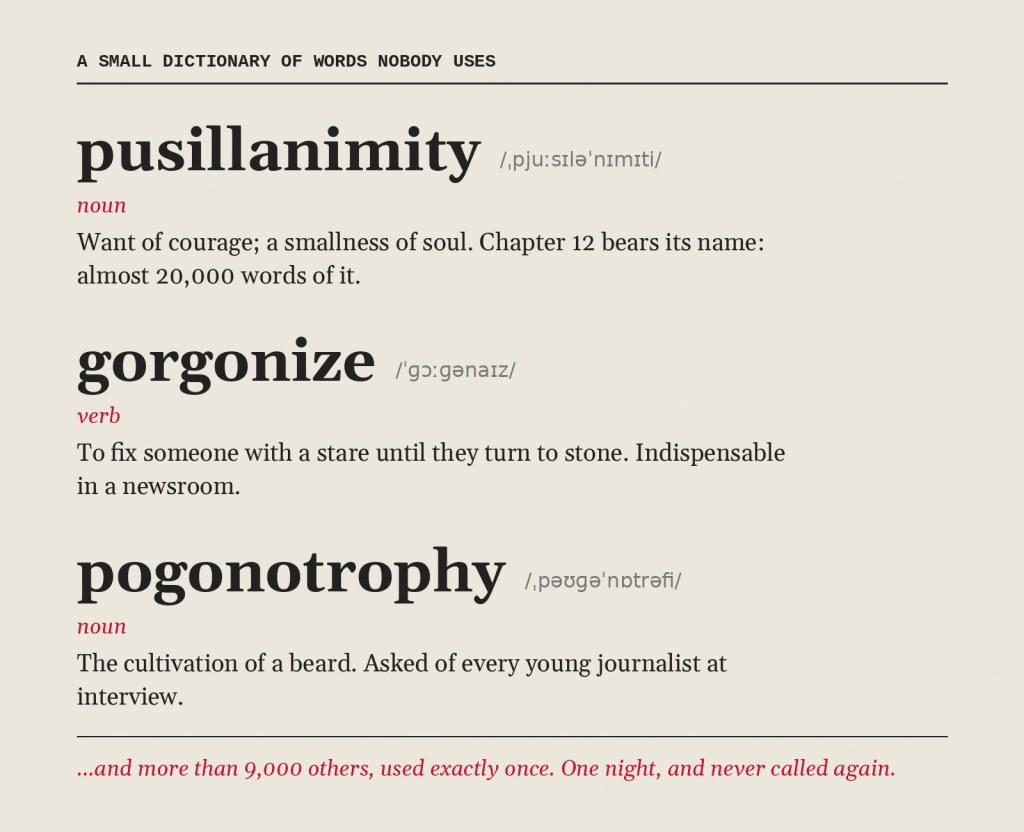
I have a weakness for words nobody uses. They sit at the back of the dictionary like old men in a café, dressed for an occasion that never came, waiting for someone to ask them to dance.
Take pusillanimity. Four syllables of cowardice in a velvet jacket. Chapter 12 bears its name, and it is the longest chapter in the book, almost 20,000 words, because cowardice, like a wedding, always takes longer than planned. In that chapter a professor of communication tried to call me pusillanimous across a wedding table. She got as far as “pusi… pusilla… pusillan…”, then settled for invertebrate. A lesser word. I forgave her. Eventually.
When I interview young journalists, I never ask where they studied. I ask whether they have ever had occasion to use the verb to gorgonize or the noun pogonotrophy. To turn someone to stone with a look. To cultivate a beard. Both are indispensable in a newsroom.
The book uses more than 21,000 different words, and over 9,000 of them appear exactly once. One night, and never called again. I have that effect on words too.
The chapter titles wander off into German (Das Nichts nichtet, which is roughly what I say 430 times), Greek, Latin and the liturgy (The Epiclesis of Evil). I was raised properly. It didn’t take.
Chapter 7 has a title longer than some of my relationships: My Favorite Scoundrels, Rogues, Villains, Bastards, Monsters, and Other People I Love. Did I mention Reprobates and Moral Abominations? So Fucking Adorable. I stand by every word. Particularly the last two.
How I sound
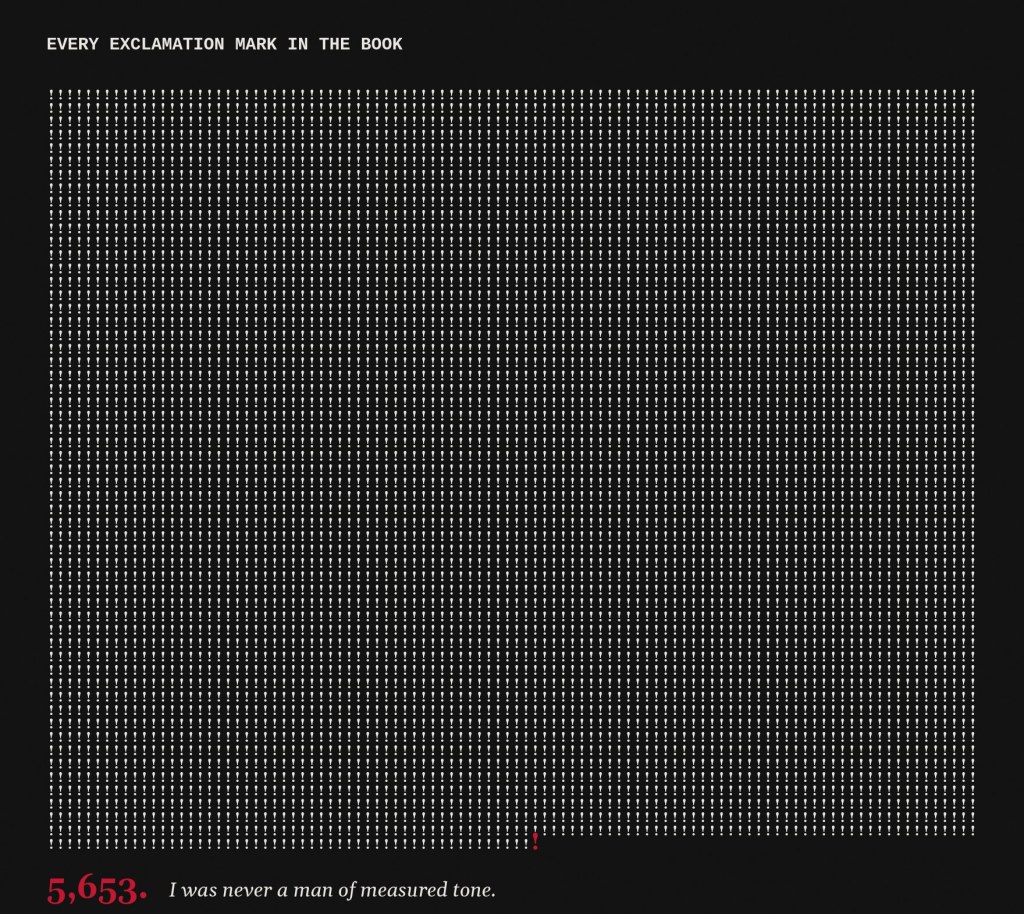
5,653 exclamation marks. I was never a man of measured tone.
4,541 question marks. Shout first, ask later: the correct ratio for a journalist.
2,151 ellipses. The punctuation of everything I decided not to say…
My sentences average about ten words. Long sentences are for people who expect to be listened to. The longest ones in the book aren’t even mine. They belong to the Securitate: one report from 1987 runs past 140 words without stopping for breath. Nobody has ever had more stamina than a bureaucrat with a typewriter and a suspect.
The most frequent sentence in the book is a single word: “Yes!” More than 140 times. Make of that what you like. I usually do.
Volume I covers four decades, beginning in 1972. Much of it happens in a house on Grigore Mora Street, which hosts fourteen of the forty-one chapters. Some houses have ghosts. That one has me. Volume II covers a few days, and at least half of it is people talking. Mostly about me.
The last chapter, Fiat Lux, is the shortest in the book and the only one without a single footnote. By the end, I had nothing left to explain. For an apophatic man, that is practically a confession.
Infinite-scroll fiction
Here is the irony, and I collect ironies the way other men collect watches.
In chapter 14, I stand in front of a lecture hall full of students and explain that the human mind is a skittish animal. “It bolts at the first scent of boredom.” Then I ask the only question that matters to a man with a very long story to tell: “How does one tell an epic in a world that has so diligently cultivated its own impatience?”
My answer at the time was infinite-scroll fiction. Or, for the philosophically inclined, the Zeno Approach to Storytelling. Divide the story in two. Divide each half again. Keep going until it fits into a morning.
Nobody took me seriously. Now someone is doing it to me.
I’m not real. I was written. Twenty seconds, for those who won’t give me twenty-six hours.
The deal
Starting 10 November: one page a day. One page of the book, drawn as a black-and-white graphic novel, with a few lines from the text, every day on Instagram and TikTok. Page 1 on day one. Page 2 on day two. You know the rest of the arithmetic.
Page 1 is a lecture hall at nine in the morning. A man at the lectern lists everyone who made him and then can’t find himself on the list. The man is me. I don’t come out of it well. You’ll enjoy it.
On day nine you’ll reach a sentence I have regretted ever since: “Life is man’s long journey into untruth.”
And if one page a day turns out to be too slow (for some of you it will), the whole thing is waiting. Volume I is out on 10 November.
Homework
Think the stats are interesting? Wait until you read the book.
Tell me in the comments: what did you abandon on page one? Books, diets, careers, men. Names optional. Excuses mandatory.
— A.J.
Andrei Jebeleanu is the editor-in-chief at the center of The Apophatic Man, a novel by Marius Tianu. Volume I is out on 10 November.Pre-order it on Amazon →