VISCERAL JOURNALISM · LESSON 001
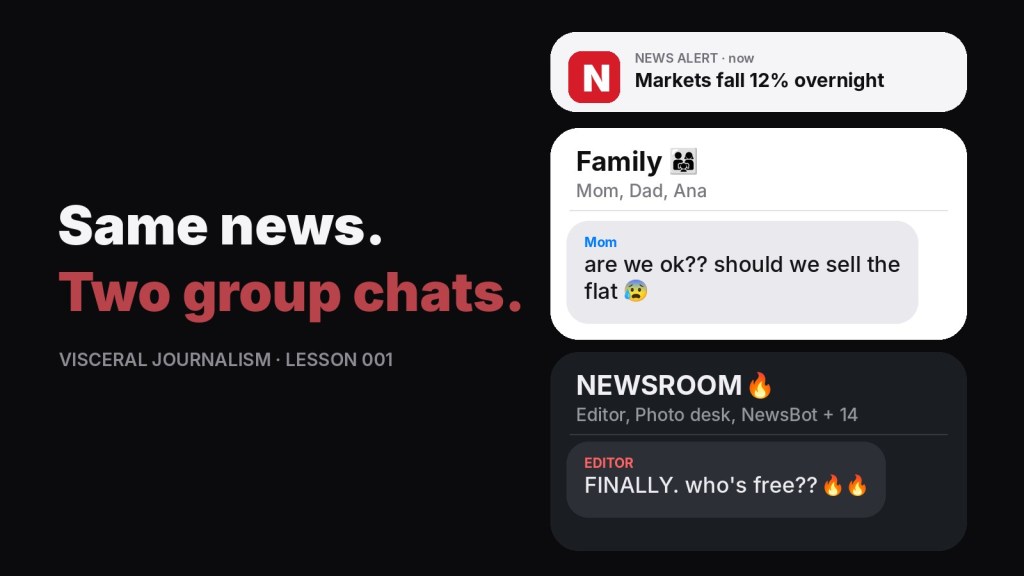
Same news, two group chats. Your family panics. My newsroom celebrates. A short lesson on the indecent pleasure of being present when the brakes fail.
My faculty banned my course. About three hundred students turned up for it, which was the first problem. The second was that I delivered it in a hall the dean’s wife regarded as her living room. The course was suspended by unanimous decision. The students signed a petition. The faculty acknowledged receipt and did nothing.
So I am teaching it here. Lesson one is the one nobody in my profession likes to say out loud.
Open two group chats
In the first one, your family. A notification slides down from the top of the screen: markets fall 12% overnight. Your mother asks whether you should sell the flat. Your father wants to know what happens to pensions. A week later it is the hottest October ever recorded, and your sister cannot sleep because it is thirty-one degrees in her bedroom.
In the second one, my newsroom. The same notification arrives. The editor types one word: FINALLY. Then: who’s free? Then: cancel everyone’s weekend. When October breaks its record, the photo desk asks for sweating children by six.
Nobody in the second chat is a monster. That is what makes it worse.
The indecent pleasure
I once tried to explain this to a dean, at a wedding, at table seven, which is where most of my academic career was decided. He had asked me what was wrong with his faculty. I told him that the people it should be producing are witnesses to humanity’s most extravagant failures, and that they need the temperament to remain fascinated by them.
“History skids, governments collapse, institutions rot, and somewhere a reporter experiences the indecent pleasure of having been present when the brakes failed.”
The dean nodded thoughtfully. His wife looked as though she were considering whether the centerpiece could be used as a weapon.
I meant it as a diagnosis, not a boast. A reporter needs an appetite for disappointment. Not cynicism, exactly. Cynicism is too comfortable. It expects nothing and is therefore never surprised. The journalist is the stranger animal: he keeps expecting better, against overwhelming evidence, and feeds on the wreckage when better fails to arrive. That is the pathology of the trade. We are sustained by the remains of our own idealism.
Everyone has a press pass now
For a long time this was our private vice. The front row of the catastrophe was reserved for people with a press card and a deadline.
Not anymore. Everyone now carries a front-row seat in their pocket. When something breaks, the crowd films before it runs. We type “how terrible,” and then we check whether there is footage. We refresh. The feed is a newsroom chat with a few billion editors, and every one of them has felt the small, shameful lift of the word BREAKING.
“The old catalogues of sin have never enjoyed better distribution. We merely call them current affairs.”
So the joke in the second chat is not really about journalists. It is about the reader holding the phone a little closer while the brakes fail.
The last headline
Then a fourth notification arrives in both chats: AI now writes 40% of all news.
My mother asks whether my job is all right. In the newsroom, the editor types: …who’s writing this one? Three dots appear. A bot answers: Done. 1,200 words. You can all go home.
That is the moment the second chat goes quiet. We had enjoyed the end of the world professionally. It had not occurred to us that we might be part of the inventory.
Which is, I suspect, the whole lesson. The pleasure of watching lasts exactly until you become the story. Life is man’s long journey into untruth, and the most consequential untruth of all is the one he harbors about himself: that he is only ever in the audience.
Homework
Which headline made you secretly happy this year? Not the one you shared. The one you refreshed.
Answer in the comments below, or under the lesson on TikTok and Instagram. The most honest answers will be read out, without names, in Lesson 002.
— A.J.
Andrei Jebeleanu is the editor-in-chief at the center of The Apophatic Man, a novel by Marius Tianu. Volume I is out on 10 November. Pre-order it on Amazon →
Follow the course: TikTok @andreijebeleanu · Instagram @andreijebeleanu

